
A Producer’s Guide to Mastering Theatre Props
On stage, a prop can be anything from a sword in a Shakespearean duel to a smartphone in a modern play. They're the physical objects actors interact with, and they're absolutely crucial for telling a story, establishing the setting, and revealing character details without a single word of dialogue.
The Unspoken Dialogue of Theatre Props

Props are far more than just objects scattered around a stage; they are the silent storytellers of a production. Think of them as a form of unspoken dialogue, bridging the gap between the world on stage and the audience's imagination. A weathered, leather-bound book can instantly transport us to a dusty, forgotten library, while a sleek laptop immediately sets the scene in a contemporary corporate office.
These items are never just background noise. They are active participants in the narrative, revealing a character’s personality, their social standing, or even their state of mind. A meticulously organised desk, for example, suggests an orderly character, whereas a cluttered one might hint at chaos or stress.
What Separates Props from Scenery
It’s easy to get tangled up distinguishing between props, costumes, and set dressing, but the defining factor really boils down to one thing: interaction. If an actor handles an object as part of their performance, it’s a prop.
-
Props: Items directly manipulated by actors, like a teacup, a letter, or a walking stick.
-
Costumes: Anything worn by an actor, from their clothes and shoes to accessories like hats or jewellery.
-
Set Dressing: The objects that furnish the environment but aren't handled by actors, such as curtains, rugs, or paintings on the wall.
This distinction is critical for keeping a production organised, but the line can sometimes blur. A cushion on a sofa is just set dressing until an actor picks it up and throws it in a fit of rage—at that moment, it becomes a prop. A classic piece of furniture, like one of these impressive Chesterfield wingback chairs, often functions as a 'set prop' that grounds a scene in a specific period and social class.
The Historical Importance of Props
The use of physical objects to enhance storytelling has been a cornerstone of theatre for centuries. During the English Renaissance, London’s theatre scene absolutely exploded. By 1610, playhouses were accommodating over 10,000 spectators a day. To keep these huge audiences engaged, acting companies relied heavily on a versatile array of props to build their immersive worlds.
They were performing up to six days a week, rotating through around 23 different plays in a single season. This prolific pace proves just how vital props were to the theatrical economy and the very act of storytelling.
A prop isn't just what a character holds; it's an extension of who they are and the world they inhabit. It’s the history they carry, the choice they're about to make, or the secret they're trying to hide, all contained within a single object.
Ultimately, props are the tangible connection between the actors and their fictional reality. They add layers of detail and authenticity that dialogue alone can never quite capture, making them a non-negotiable part of any compelling stage or screen production.
Understanding the Four Core Prop Categories
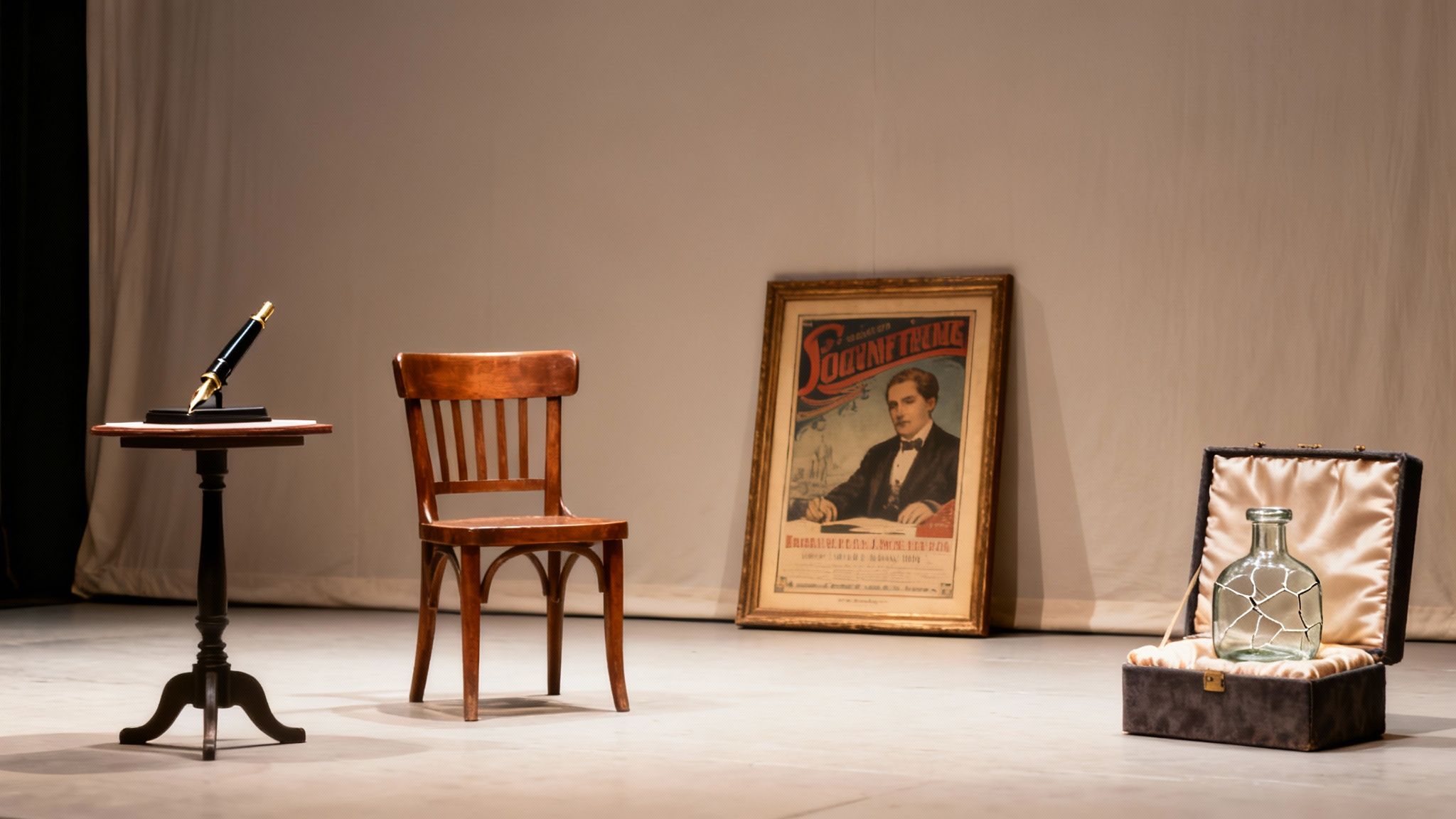
To get a handle on the hundreds of items a production might need, you have to speak the same language as everyone else on set. Trying to manage every single object without a system is like trying to build a house without a blueprint—it’s just organised chaos. The world of theatre props is thankfully broken down into four core categories, each playing its own part in bringing the story to life.
Getting your head around this system turns a daunting shopping list into a workable plan. It makes it crystal clear who is responsible for what, simplifies the budgeting process, and ensures every object on stage actually has a purpose.
Hand Props: The Actor's Tools
First up are hand props, and they’re exactly what they sound like: any object an actor picks up, handles, or directly interacts with during a scene. They are the tools of the performance, the physical items that drive the action and reveal a character's personality. Think of the letter an actor reads aloud, the pen they use to sign a document, or the mobile phone they keep checking.
These objects are deeply tied to the performance itself. A character who pulls out a battered old notebook tells you a completely different story than one who uses a pristine, expensive journal—all before they've even uttered a line.
Because they're so vital to the action, hand props need to be tracked meticulously. They’re laid out on a prop table backstage for actors to grab at just the right moment, making them the direct responsibility of the stage management team during a show.
Set Props: Furnishing the World
Next, we have set props. This category covers the big stuff—mostly furniture and large items that define the physical space. A dining table, a throne, a bookshelf, or an office desk all fall under this umbrella. While actors might interact with them, like sitting on a chair, these items are generally static and considered part of the overall set design.
Set props are the anchors of a scene. They establish the location, the time period, and the social standing of the characters. A grand, ornate chaise longue instantly places you in a wealthy, historical household, while a simple metal stool suggests a modern, maybe even industrial, setting.
Set props are the foundational elements of the world you are building. They don't just fill the stage; they create the context in which the story unfolds, giving characters a believable space to exist and interact.
These larger pieces are typically moved into position by the stage crew during scene changes and are seen as part of the scenic design, even though they fall under the props department's management.
Set Dressing: Adding Atmosphere and Detail
Set dressing includes all the bits and pieces that add texture and atmosphere to a room but aren't actually handled by the actors. Think of the curtains hanging in a window, the posters on a teenager's bedroom wall, or the dusty collection of books lining a study's shelves.
These objects are what make a space feel lived-in and believable. They add layers of detail that tell a story about the people who inhabit that world. A messy stack of newspapers on a coffee table, for instance, might suggest a character is overwhelmed or politically engaged.
The crucial difference here is the lack of direct interaction. If an actor suddenly pulls one of those books from the shelf to read it, that book instantly transforms from set dressing into a hand prop. This category is all about building the visual mood.
Specialty Props: Creating Unique Effects
Finally, we have specialty props. This is a catch-all category for anything that needs a unique function, involves a special effect, or has to be custom-built from scratch. These are often the props that create the most memorable moments on stage.
Examples include things like:
-
Breakaway Props: Items designed to smash safely on impact, like a sugar-glass bottle or a balsa wood chair.
-
Consumable Props: Any food or drink that an actor actually eats or drinks during the performance.
-
Special Effects Props: Objects that produce smoke, fire, or other controlled visual effects.
-
Custom Gadgets: Unique, often electronic, devices built specifically for the production that don't exist in the real world.
These props demand specialist knowledge to create and operate safely. They're usually the most complex to source or build and can have a big impact on the budget and production timeline, requiring careful planning right from the start.
To make this all a bit clearer, here’s a quick breakdown of how these categories function in practice.
Prop Categories and Their Functions
| Prop Category | Definition | Key Function | Example |
|---|---|---|---|
| Hand Prop | An object directly handled or used by an actor. | Drives action, reveals character. | A sword in a fight scene; a teacup a character drinks from. |
| Set Prop | Large items, primarily furniture, that define the space. | Establishes location, period, and social context. | A sofa in a living room; a throne in a king's court. |
| Set Dressing | Items that add atmosphere but are not handled. | Creates a believable, "lived-in" environment. | Curtains on a window; posters on a wall. |
| Specialty Prop | A custom-built or functional prop with special effects. | Creates a specific, often dramatic, on-stage effect. | A breakaway bottle; a prop that smokes on cue. |
As you can see, each category has a distinct and vital role. Understanding the difference isn't just about industry jargon; it’s about building a believable world, one carefully chosen object at a time.
Choosing Props That Enhance the Story
Selecting the right theatre props is a true art form. When it's done well, the perfect prop melts into the scene, feeling so natural the audience barely registers it's there. Get it wrong, however, and a single out-of-place object can shatter the world you’ve painstakingly built, yanking the audience right out of the moment.
This isn’t just about finding something that looks the part. It’s a delicate dance between research, practicality, and pure stagecraft. To make sure every item on your stage serves the story, you need to master three critical pillars: historical accuracy, practical scale, and audience sightlines.
The Pillar of Historical Accuracy
Nothing destroys the magic of a period drama faster than a glaring anachronism. Picture a play set in Victorian London, and a character casually pulls out a ballpoint pen. In that instant, the entire scene’s credibility evaporates. This is exactly why deep, thorough research is the bedrock of believable prop selection.
Historical accuracy is more than a quick Google search. It means getting under the skin of an era—understanding the materials they used, how things were made, and what everyday objects actually looked like. If your production is set in the 1950s, for instance, a telephone prop shouldn't just be a rotary phone; it should be made of bakelite, not modern plastic.
Authenticity is about more than just aesthetics; it's about respecting the world you are creating. Every prop, from a simple teacup to a piece of furniture, should feel like it truly belongs to the time and place of the story.
This obsessive attention to detail is what convinces an audience the world on stage is real, letting them fully invest in the characters and their journey.
The Pillar of Practical Scale
Beyond historical context, a prop has to look right in the hands of an actor and on the set itself. The concept of scale is essential for maintaining visual harmony. A prop that’s too big or too small can look comical or just plain wrong, completely distracting from an actor's performance.
Think about an actor carrying a briefcase. If it’s absurdly oversized, it becomes a sight gag instead of a functional hand prop. On the other hand, a tiny, delicate fan might completely disappear in the hands of a tall actor on a massive stage.
To get the scale right:
-
Consider the Actor: Choose props that suit the actor's physique and are easy for them to handle in character.
-
Evaluate the Set: Make sure furniture and other large props are proportional to the performance space. A massive four-poster bed will completely overwhelm a small black box theatre.
-
Test in Rehearsal: The only way to truly know if the scale works is to get the prop in the room and see it in action during rehearsals.
The Pillar of Audience Sightlines
The final pillar is perhaps the most practical of all: can the audience actually see the prop? A crucial object that drives the plot is totally useless if it’s invisible to half the theatre. Sightlines—the lines of sight from different seats to the stage—have to be a top priority.
If a character is reading a vital letter, it needs to be held and positioned so the audience understands its importance, even if they can't read the words. This might mean the actor holds it at a specific angle, or the lighting designer uses a subtle spotlight to draw the eye. For a deeper dive into making these choices, our guide offers more insights on how to choose props that truly enhance your story.
Stage managers and directors will often sit in various seats around the auditorium—from the back row to the far sides—just to make sure every important bit of action is visible. The size, colour, and placement of a prop are all tweaked to guarantee it has the intended impact, no matter where you're sitting. Get these three pillars right, and your props stop being mere decorations and become powerful tools for storytelling.
When to Hire Theatre Props
Hiring is almost always the most efficient and budget-friendly route, especially for those hard-to-find or period-specific theatre props. Need an authentic 1930s wireless or a set of medieval goblets? A good prop hire company will have them on a shelf, ready to go. This saves you countless hours you’d otherwise spend trawling antique shops or building something from nothing.
It’s the no-brainer choice for items you’re unlikely to ever need again.
There’s also a sustainability angle. Instead of making something new for every show, you’re plugging into a circular economy that massively reduces waste. Major institutions like The National Theatre in London have huge prop hire departments for this very reason, serving productions all over the UK. It’s a smart, efficient way to work.
When Building Is the Only Option
Then there are the times when you have to build. This is where the real craft comes in, but it’s also the most demanding on your time, budget, and skills. You only go down this road when an object is so unique, or has such a specific function, that nothing off-the-shelf will do.
Building a prop is for when the story demands something that simply doesn’t exist in the real world. It’s where the prop-maker’s job shifts from sourcing to pure creation, making sure the physical world of the play is as original as the script.
This is the world of speciality props—things like:
-
Unique inventions that are central to the plot.
-
Breakaway furniture designed to shatter safely and dramatically on cue.
-
Props with hidden modifications, like a book with a secret compartment or a portrait with moving eyes.
Building requires skilled hands, a proper workshop, and a deep understanding of materials and safety. For a deeper dive into the pros and cons, check out our guide on DIY vs professional prop hire. It’s a decision you should never take lightly, but for those truly one-of-a-kind moments on stage, it’s the only way to make the magic happen.
Managing Your Prop Budget and Logistics
Finding the perfect prop is only half the battle. A stunning period telephone is a creative win, but if it blows your budget or arrives late, it’s a production nightmare. This is where the real work begins—the meticulous, unglamorous, and absolutely essential job of managing the money and the logistics.
Think of it this way: prop selection is the art, but budgeting and logistics are the craft. Getting it right is the bedrock of any smooth, professional operation.
Building a Bulletproof Prop Budget
Your props budget isn't just a number scribbled on a notepad; it's your production's financial playbook. A vague budget is a recipe for disaster, leading to last-minute panics and painful creative compromises. A great one anticipates every possible cost and keeps the entire department accountable.
Get granular. Break everything down into specific line items. This detail isn't just for the accountants; it allows you to see exactly where the money is going and make smart decisions if cuts are needed later.
Your budget should always include:
-
Hire Fees: The cost of renting items from professional prop houses.
-
Purchase Costs: The money set aside for buying props, especially common items or pieces you’ll keep for your company.
-
Material and Build Costs: Funds for timber, paint, fabric, and anything else needed to build props from scratch.
-
Contingency Fund: This is non-negotiable. Always, always set aside 10-15% of your total prop budget for the unexpected. A last-minute replacement, a surprise shipping fee—it will happen.
A prop budget is more than a spreadsheet; it’s a strategic plan. It forces you to justify every choice, ensuring that each pound spent directly serves the story you are trying to tell on stage.
This isn’t a new idea. Keeping a close eye on the finances behind the magic has been essential for centuries. One of the earliest records, from 1716 at the Theatre Royal, Drury Lane, shows detailed accounts for everything from a truss of straw (1 shilling) to stage blood (2 pence). As you can explore in these insights into theatre history, managing the pennies has always been part of the show.
Mastering Prop Logistics
With your budget locked in, the focus shifts to the physical journey of each prop—from the prop house to the stage and back again. When logistics work, nobody notices. When they fail, everyone feels it. A missed delivery or a damaged return can throw a wrench into the entire production schedule.
Your key tasks here are scheduling transport, organising safe storage, and managing returns. For hired items, this means coordinating collection and delivery times that fit perfectly with your production timeline. Never leave transport until the last minute; you'd be surprised how quickly vans and couriers get booked up.
Safe Storage and Smooth Returns
Once the props land, they need a safe and organised home. Designate a specific area backstage or in a workshop, well away from high-traffic zones where things can get knocked about. Use clear labels and inventory lists to track every single item. This is your lifeline during the controlled chaos of tech week.
Managing returns is just as critical as receiving. To avoid nasty surprise fees from a prop hire company, make this your mantra:
-
Document Everything: Snap photos of hired props the moment they arrive to record their condition. This is your proof.
-
Repack with Care: Use the original packaging. It was designed to protect the item, so use it to send it back safely.
-
Hit Your Deadlines: Return everything on the agreed-upon date. Late returns almost always come with penalty charges that will eat into that contingency fund you so cleverly set aside.
By treating the budget and logistics with the same creative respect you give to choosing the props, you ensure the backstage machine runs as beautifully as the performance itself.
Your Guide to Prop Handling and Maintenance
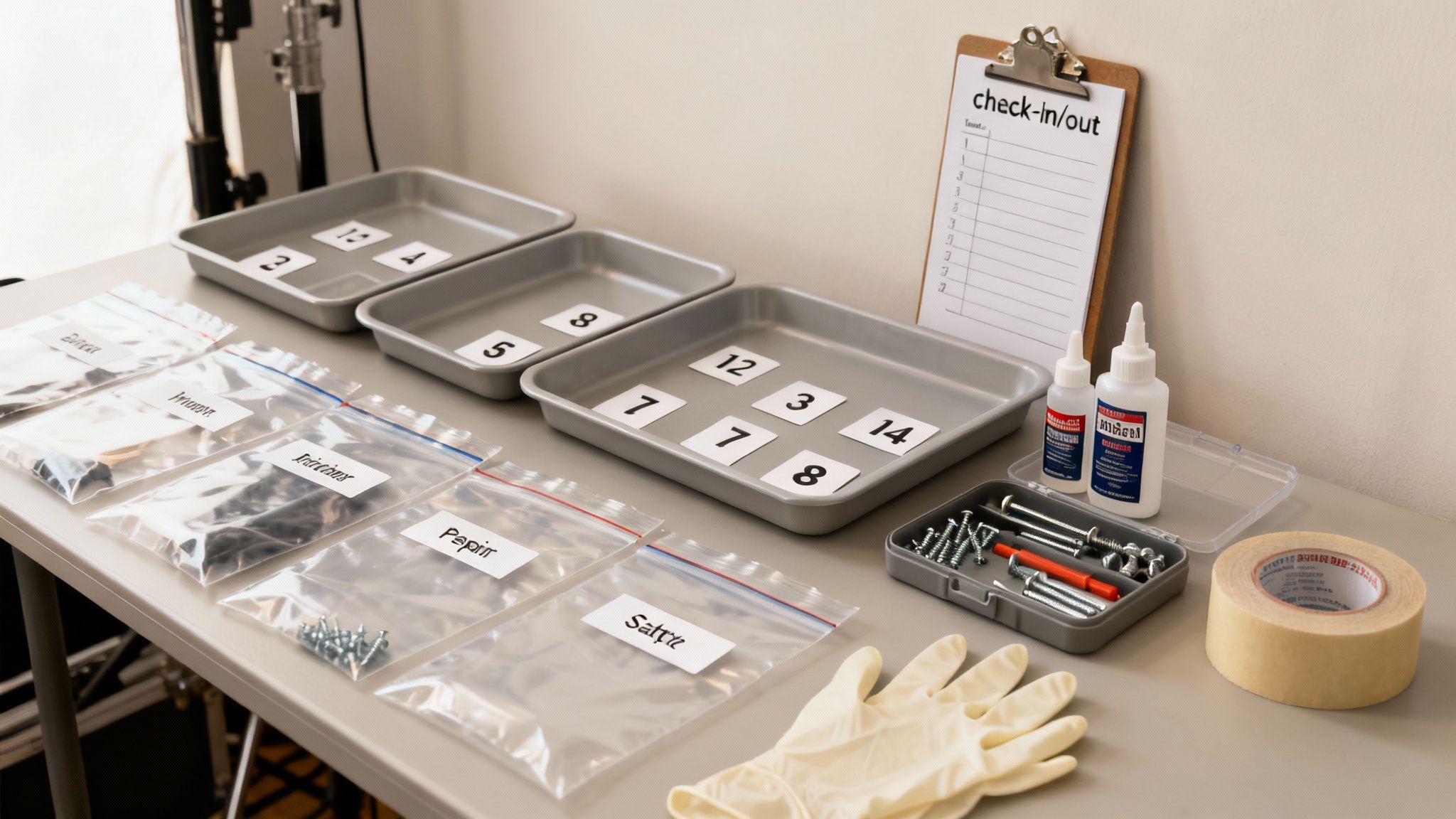
Props are the workhorses of any production. They get handled, dropped, and moved around constantly, which means they’re always at risk of damage or simply disappearing into the backstage void. Good prop handling and maintenance isn't just about keeping things looking nice; it’s about making sure every single performance is consistent and, most importantly, safe.
This whole process starts at the prop table, the command centre for every single item that makes its way on and off the stage. A well-run table is the secret to a smooth show. It prevents missed cues and stops those frantic, heart-stopping backstage searches. This isn't just a random pile of stuff; it's a carefully laid-out map that mirrors the show's running order.
Organising the Backstage Prop Table
The real trick to a functional prop table is a system so obvious that anyone can understand it, even in the dim, chaotic light of backstage. The aim is to make grabbing the right prop at the right moment completely foolproof for both actors and crew.
One of the simplest and most effective methods I’ve seen is to trace each prop's outline onto paper covering the table, then clearly label the shape. This gives every single item a visual "home," making it glaringly obvious if something hasn't been returned.
To get that level of clarity, you should:
-
Zone by Actor or Scene: Group all the items needed by a particular actor or for a specific scene together. This cuts down on confusion and makes transitions so much faster.
-
Use Bins and Trays: Don't underestimate simple organisers. They stop smaller theatre props from rolling away or getting lost in the shuffle during a quick change.
-
Implement a Check-In System: Create a straightforward checklist for the stage management team to run through before each act. This quick inventory check confirms every prop is where it should be and correctly reset for its next entrance.
Essential Prop Safety Protocols
Beyond keeping things organised, safety is absolutely paramount when you're handling props. From replica weapons to food that gets eaten on stage, every item has its own risks that have to be managed to keep the cast and crew protected. And that responsibility falls on the entire production team.
Every production needs to have clear, non-negotiable safety rules from day one. This covers everything from ensuring any food used on stage is fresh and stored properly to avoid illness, right through to requiring specific training for more complex items.
A prop is only as effective as it is safe. A stunning special effect or a realistic replica weapon becomes a massive liability the moment its handling protocols are ignored. The safety of your performers and crew has to come first, always.
Managing Speciality Prop Risks
Some props demand an extra level of vigilance. The rules for these items are strict for a reason and must be followed to the letter, without any exceptions.
-
Replica Weapons: Every single replica firearm and edged weapon must be treated as if it were real. That means storing them securely, checking them before and after every single use, and ensuring they are only ever handled by trained individuals.
-
Fire and Flame Effects: Any prop that involves an open flame has to comply with strict fire safety regulations. This includes using fire-retardant materials wherever possible and having fire extinguishers easily accessible backstage. No excuses.
-
Breakaway Items: Even though things like sugar glass or balsa wood furniture are designed to break safely, they still need careful handling. You need to prevent them from breaking accidentally and make sure they shatter exactly as intended on cue.
By marrying meticulous organisation with rock-solid safety protocols, you create a backstage environment where the props are looked after, and everyone involved in the show can do their job with confidence.
Common Questions About Theatre Props
When you’re deep in the thick of a production, the same questions tend to pop up time and time again. It’s the practical, on-the-ground stuff that can trip you up if you don’t have a quick answer. From sorting out roles to nailing down timelines, clarity is everything.
Think of this as your go-to guide for those nagging queries. It’s a way to reinforce the core ideas we've covered and give you a handy reference to keep your production running without a hitch.
What Is the Difference Between a Prop and Set Dressing?
This is easily the most common point of confusion I hear, but the distinction is actually quite simple. It all boils down to one word: interaction.
A prop is any object an actor handles or uses as part of their performance. Think of a teacup they drink from, a letter they read, or a sword they wield in a fight scene. If an actor physically interacts with an item to move the story forward or reveal something about their character, it's a prop. Simple as that.
Set dressing, on the other hand, is all the stuff that fills the world of the play but isn't directly handled by the actors. These are the items that build atmosphere and context. It’s the curtains hanging in the window, the books lining a shelf (unless one gets picked up and read), or the art on the walls. If it's there to establish the environment, it's set dressing.
How Early Should I Start Sourcing Props?
My advice is always the same: start looking the moment your script and set design are locked in. For most theatre productions, this means getting the ball rolling 4 to 8 weeks before opening night. That window is crucial for researching period details, getting quotes from hire companies, and scheduling delivery.
But some things need even more time.
If you need a custom-built speciality prop or a particularly rare period piece, you could be looking at several months of planning. Popular prop hire companies get booked up well in advance, so getting in early gives you a vital buffer for any unexpected headaches and time to find a backup if your first choice is already taken.
Who Is Responsible for Props During a Live Show?
While one department is in charge of getting the props into the building, that responsibility shifts once the curtain goes up. It becomes a slick, coordinated team effort with very specific roles.
The Props Master (or the Props Department) has the job of sourcing, building, and prepping every single prop before the show opens. They’re the ones who make sure everything is ready and working for rehearsals and the first night.
But once the performance starts, the Stage Management team takes over. The Stage Manager and their assistants are in charge of the prop tables backstage, making sure every item is in exactly the right place for each scene, and tracking everything as it comes on and off stage. During the show's run, they become the absolute guardians of the props, guaranteeing everything is perfect, night after night.
At House of Props, we get the immense detail that goes into every production. With over three decades of experience under our belts, our curated collection is here to help you find the perfect items to bring your creative vision to life. Explore our extensive catalogue and let us help you tell your story. https://www.houseofprops.uk