
A Guide to Props for Theatre and Stage Productions
Every object on stage tells a story, yet it's easy to overlook just how much work they do. Props for theatre are the unspoken language of a play—that misplaced letter can trigger a tragedy, while a worn-out armchair can reveal a character's entire life story. These items are the silent storytellers, the details that breathe life into a performance.
The Unsung Heroes: What Are Props for Theatre?
At its most basic, a prop is any moveable object that appears on stage during a show, either used by an actor or placed to dress the set. But that definition barely scratches the surface. A prop isn't just an object; it's a vital piece of the narrative puzzle, chosen with immense care to build worlds, define characters, and drive the plot.
Think of the stage as a blank canvas. The actors are the main subjects, but the props are the crucial brushstrokes that add all the depth, texture, and meaning. They anchor the performance in a tangible reality, making the fictional world feel solid and believable. A well-chosen prop can say more than a page of dialogue.

Why Every Prop Matters
Props are never just there to fill space. They are deliberate choices, each one shaping how the audience sees the story and connects with the characters. A single prop can instantly establish the time period, reveal someone's social standing, or even drop a subtle hint about what's to come.
Just consider the difference between a character sipping from a delicate porcelain teacup versus a chipped tin mug. Each object tells a completely different story about who that person is and the world they come from. That’s the quiet power of props at work.
"Memories are ethereal, just like theatre herself. But, just as we bring theatre to life by dragging it into the physical world night after night, so too can our memories be sustained by items and souvenirs."
When you get right down to it, props serve several critical functions that are absolutely essential for a successful production:
- Establishing the Setting: They are the quickest way to define the when and where of the story. A rotary telephone immediately throws the scene into the past, while a sleek tablet brings it right into the modern day.
- Defining Character: What a character owns, carries, or fiddles with offers huge clues into their personality, history, and motives. A messy desk might belong to a chaotic genius; a perfectly organised bookshelf could signal a meticulous and controlling individual.
- Advancing the Plot: Many props are the very engine of the action. This could be the dagger in a Shakespearean tragedy, the signed confession in a whodunnit, or the engagement ring in a romance. Without the prop, the story grinds to a halt.
These seemingly small details are the foundation on which believable worlds are built. They aren't just decoration; they are active participants in the storytelling. From the grandest pieces of furniture to the smallest hand-held items, every single prop on that stage is a calculated decision, all aimed at enriching the audience's experience and making the magic of theatre feel completely real.
Decoding the Stage: A Practical Guide to Prop Types
To get the most out of props for theatre, you first need to speak the language. Not all props are created equal; they fall into distinct categories based on how they’re used on stage. Getting your head around these types is the first real step in turning the creative chaos of a production into an organised plan.
This shared understanding helps everyone, from the director to the props master, communicate clearly. It ensures every single item has a purpose and a place, which is the difference between a cluttered stage and a world that feels completely real.

Hand Props: The Actor's Tools
Hand props are exactly what they sound like—any item an actor handles or carries during a scene. They are the most interactive props you’ll deal with and often play a direct role in the action. Think of them as extensions of the character, physical objects that reveal their intentions.
A perfect example is Yorick's skull in Hamlet. It’s not just an object; it’s the focal point for Hamlet’s entire monologue on life and death. Other classic examples include a letter a character reads, a sword used in a duel, or a teacup someone drinks from.
These items are absolutely vital for an actor's performance, so they have to be reliable, easy to handle, and fit for purpose. Their management is a critical backstage job, often involving a meticulously organised props table just out of sight.
Set Props and Furniture: The Foundations of the World
Set props and furniture are the larger, more static items that define the physical space. This category covers everything from sofas and tables to bookcases and grand pianos. Unlike hand props, actors typically interact with them rather than carrying them around.
These pieces are the anchors of your set. They immediately establish the location, period, and social status of the world you’re building. A huge, ornate throne tells the audience we’re in a royal court, while a single, rickety wooden stool suggests a humble cottage.
The distinction between prop categories is more than just terminology; it directly impacts budgeting, sourcing, and rehearsal schedules. Knowing whether an item is a hand prop or set dressing determines who is responsible for it and how it will be managed throughout the production.
Furniture and big set props are foundational. Their placement is carefully planned by the set designer to guide how actors move and to create powerful visual compositions for the audience.
Set Dressing: The Details That Breathe Life
If furniture builds the skeleton of a room, set dressing adds the soul. This includes all the small, decorative items that create a believable, lived-in atmosphere but aren't typically handled by the actors. This is where the world of the play truly comes alive.
These details add layers of unspoken story. Think of the books on a shelf, the pictures on a wall, the cushions on a sofa, or the half-empty glasses left on a coffee table. An actor might never touch them, but their presence makes the world feel authentic.
To help you keep these crucial categories straight, here's a quick guide.
Quick Guide to Theatre Prop Categories
This table breaks down the main types of props, their core function, and a few common examples to make the distinctions crystal clear.
| Prop Category | Primary Function | Common Examples |
|---|---|---|
| Hand Props | Items handled by actors to drive action or define character. | A sword, a diary, a fan, a telephone, a glass of water. |
| Set Props & Furniture | Large items that furnish the stage and define the space. | Chairs, tables, beds, a fireplace, a large grandfather clock. |
| Set Dressing | Decorative items that add texture and realism to the setting. | Curtains, rugs, paintings on the wall, books on a shelf, flowers in a vase. |
Of course, the line can sometimes blur. A book sitting on a shelf is set dressing, but the moment an actor picks it up and reads from it, it becomes a hand prop. This is exactly why clear communication and a detailed props list are so essential from the very beginning of any production.
Choosing the Right Props for Your Production

Selecting the right props for theatre is less of a science and more of an art. It's a delicate dance, blending meticulous historical research with the director's unique artistic vision. This isn't just about scattering objects on a stage; it's about making deliberate choices that feel authentic, push the story forward, and look just right from every single seat in the house.
To get this right, professionals lean on three core pillars that guide every decision: scale, period, and context. These principles ensure that every prop, whether it's a hero's sword or a humble teacup, helps build a cohesive and powerful world for the audience.
Nailing the Scale
Scale is all about how a prop’s size relates to the actor holding it and the stage it’s on. A prop that looks perfect up close in a small studio theatre can completely vanish on a grand West End stage. The goal is to find a visual harmony that feels natural to the audience, no matter where they're sitting.
An object might be historically accurate down to the last detail but look completely wrong under stage lights from fifty feet away. Think about it: a delicate, period-correct hand fan might be totally invisible to the back row. A savvy prop master would likely choose a slightly larger, more defined version that still captures the style but "reads" better to the entire audience.
And it's not just about the audience. The prop has to feel right in the actor’s hand. If an object is too heavy, too flimsy, or just plain awkward, it can throw off a performance. The scale has to serve the visual needs of the production and the practical needs of the performer.
Honouring the Period
Nothing grounds a play in its setting like historical integrity. Choosing props from the correct period is fundamental to building a believable world, whether you’re staging Shakespeare or a 1920s drawing-room comedy. This means doing your homework to avoid anachronisms—those jarring, out-of-place items that can pull an audience right out of the story.
In the UK theatre scene, this dedication to authenticity is a hallmark of quality. Prop teams often consult historical sources, like the V&A Theatre Archives, to ensure every detail is spot on.
Selecting props is not about finding objects from a time period; it's about finding objects that tell the story of that time period. The right prop doesn't just fit in—it speaks volumes about the world the characters inhabit.
This obsessive attention to detail is what makes a historical production feel truly immersive.
Aligning with Context and Vision
Finally, every single prop choice has to serve the director's vision and the specific context of the production. Two directors could stage the exact same play with completely different visual styles, and their prop lists would look nothing alike. One might aim for gritty realism, while another goes for minimalist symbolism.
A prop master’s first job is to get inside the director's head. This happens through deep dives into the script and long conversations with the entire design team.
Think about these two different takes on classic plays:
- A Realistic Death of a Salesman: The props would be worn and tired. You'd see a battered briefcase, scuffed shoes, and mismatched kitchenware to reflect Willy Loman's financial and emotional decay.
- A Stylised Macbeth: The director might ditch traditional daggers and instead use shards of mirrored glass to symbolise fractured identities and distorted ambition.
The context is everything. It dictates whether a prop needs to be historically precise or artistically abstract. A prop is never chosen in a vacuum; it has to fit into the show's broader aesthetic and thematic world. For a deeper look at this, check out the prop master's guide on how to choose props that enhance your story. Ultimately, the best props are the ones that feel inevitable—as if they could belong to no other character in no other version of that world.
Managing Prop Safety and Rehearsal Protocols
Once the creative choices are made, the real responsibility kicks in. Props for theatre aren't just decorative items; they are physical objects actors handle under pressure, often in low light while executing complex choreography. A prop master’s most critical job is ensuring the absolute safety of the cast and crew. This is non-negotiable.
This means shifting your focus from pure aesthetics to rigorous safety checks and smart rehearsal planning. Every single item, whether it’s a simple drinking glass or a complex electronic gadget, has to be assessed for potential danger. Getting this right from the start prevents accidents and keeps the production running smoothly, from the first table read to the final curtain call.
The Importance of Risk Assessments
Some props demand more than just a quick once-over; they require a formal risk assessment. This is especially true for anything with inherent danger, like stage weapons, breakaway glass, or props involving fire, water, or electricity. A proper assessment doesn't just flag the dangers; it lays out a clear, step-by-step plan to minimise them.
These specialist props need meticulous handling and dedicated training. The goal is always to create a controlled, predictable environment where every action has been rehearsed to the point of instinct.
Key areas to cover in a prop risk assessment include:
- Stage Weapons: This category covers everything from replica firearms to blunted swords. Your protocol must detail secure storage, strict handling procedures, and compulsory training for any actor who even touches the weapon.
- Breakaway Items: Things like sugar-glass bottles or balsa wood furniture are designed to shatter safely on cue. The assessment must confirm they're built correctly and establish a clear 'safe zone' to protect anyone nearby when the action happens.
- Electronics and Pyrotechnics: Any prop that gets plugged in or involves a naked flame needs to be checked and certified by a professional. This means ensuring all wiring is sound, insulation is intact, and you're following every single fire safety regulation to the letter.
Using Rehearsal Props Effectively
One of the best tools for both safety and preservation is the humble rehearsal prop. These are simple stand-ins used during rehearsals instead of the final, often expensive or delicate "hero" props. This practice is invaluable for a couple of major reasons.
First, it protects your hero props from weeks of wear and tear. That antique cane or priceless vase can stay in pristine condition for the actual performances while actors work with a simple wooden dowel or a cardboard cut-out.
Rehearsal props are more than just stand-ins; they are crucial tools for muscle memory. They allow actors to perfect their timing, movement, and interaction with an object long before the delicate or dangerous final version is introduced, making the performance safer and more fluid.
Second, rehearsal props let actors build confidence and physical familiarity without any risk. An actor can run a fight scene hundreds of times with a weighted rubber sword, making sure every move is precise and safe before they ever pick up the blunted steel version.
This process is fundamental to professional theatre. It gives performers the space to experiment and get it right, ensuring that when the real props finally make their entrance, using them is second nature. It's this careful, methodical approach that defines a safe and professional production.
Budgeting for Props: When to Rent vs Buy
Getting the money side of prop management right is every bit as important as the creative decisions. A well-thought-out budget for your props for theatre stops last-minute panic and makes sure the director’s vision comes to life without emptying the bank account. This whole process kicks off long before you source a single item, starting with a deep dive into the script to build a complete list of every single prop you'll need.
That initial list is the foundation of your budget. From there, you can start putting estimated costs against each item, whether you plan to build, buy, or hire it. Think of it as your financial roadmap – it’s what allows you to make smart, strategic choices that serve both the artistic and practical needs of the show.
This decision tree gives you a framework for thinking about special props versus everyday items.
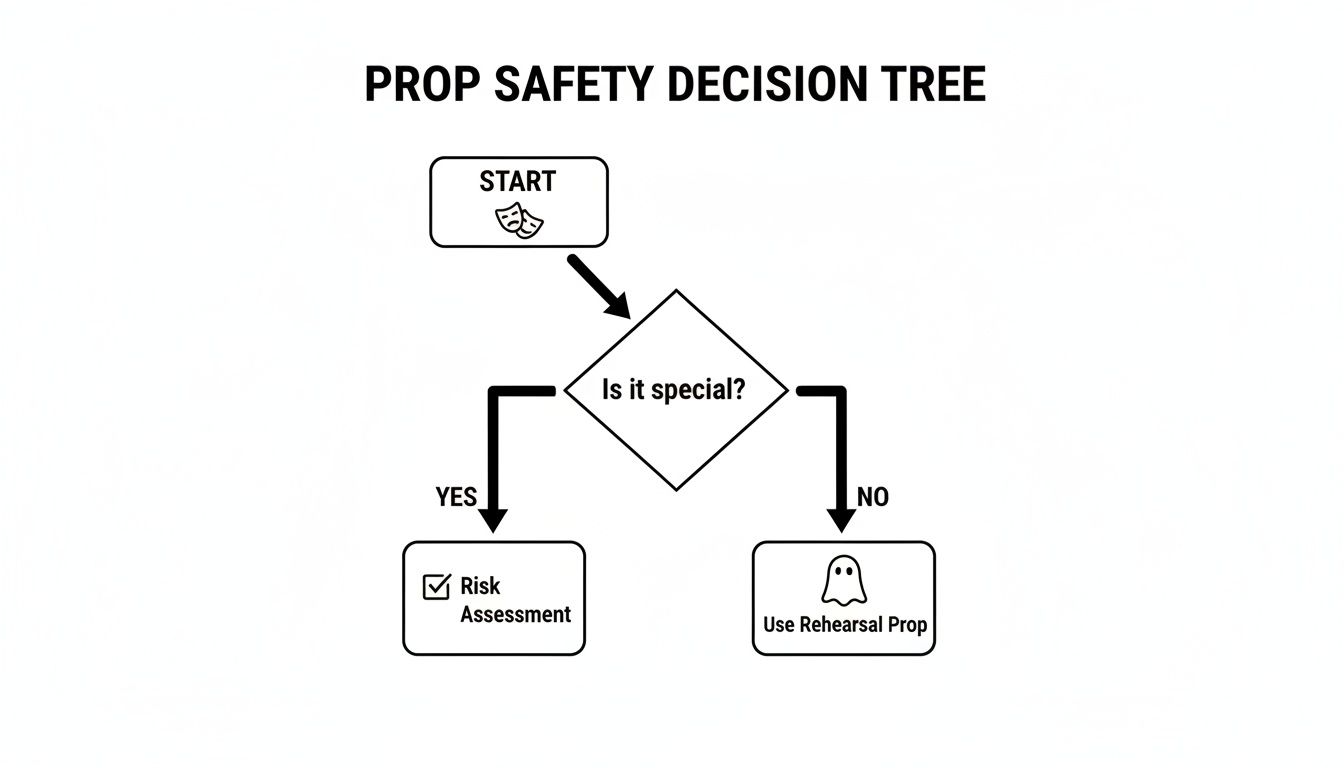
As the flowchart shows, any specialised prop demands a proper risk assessment. For standard items, using rehearsal props is a smart move to protect the final, show-ready versions from unnecessary wear and tear.
The Critical Rent vs Buy Dilemma
The big question every props manager wrestles with is whether to rent or buy an item. There’s no easy answer. The right choice is always a careful balance between an item's uniqueness, how often you might use it again, and your overall budget. Nailing this decision is the secret to making your funds stretch as far as they possibly can.
As a general rule, buying makes sense for generic, hard-wearing items you’re likely to reuse in future shows. Think everyday glassware, simple cushions, or common books. You can often pick these up cheaply and add them to your company’s own prop store, saving money down the line.
Renting, however, is the perfect solution for specialist or period-specific pieces. A production set in the 18th century might need an ornate grandfather clock or a Louis XVI chaise lounge. Items like these are not only expensive to buy but also need specialist storage and care, making hiring a much more practical and cost-effective option.
Making the Right Financial Choice
To make the choice easier, create a simple checklist for each major prop on your list. This really helps to clarify the most sensible way forward.
Here are the key things to consider:
- Uniqueness and Specificity: Is it a one-of-a-kind piece that's central to the plot but you'll probably never use again? If so, rent it.
- Frequency of Use: Is it a common item that could pop up in lots of different productions in the future? If yes, it might be a smart purchase.
- Storage and Maintenance: Do you actually have the space and resources to store and look after the item once the show closes? If not, renting saves you from that long-term headache.
- Budget Impact: Does buying the item eat up a huge chunk of your budget, leaving pennies for everything else? Hiring frees up cash for other essential props.
The goal isn't just to get props; it's to get them smartly. A successful props budget is a testament to clever problem-solving, where every pound is squeezed for the greatest possible impact on stage.
This kind of strategic thinking is vital. For example, some productions invest heavily in high-value props that can be amortised over decades of performances. This shows how props directly fuel the industry’s success and enhance the audience experience.
Creative and Sustainable Sourcing
A tight budget doesn't mean you have to skimp on quality. Some of the most memorable stage worlds are built on pure ingenuity and resourcefulness. This is where creative sourcing becomes one of your most valuable skills.
Charity shops, car boot sales, and online marketplaces can be absolute goldmines for unique and affordable finds. A little bit of creative TLC—a quick coat of paint or some new fabric—can turn a boring discovery into the perfect prop. Knowing the difference between a DIY job and when you need a professional solution is a crucial skill for any production manager. You can dig deeper into this by understanding when DIY is appropriate versus when to opt for professional prop hire. This approach isn't just easy on the wallet; it’s also sustainable, giving old objects a new lease of life on stage.
How to Work with a Professional Prop House
Walking into a professional prop house can feel like finding a treasure chest for your production. Instead of spending days hunting for that one perfect period telephone, you suddenly have access to a massive, curated collection and decades of practical expertise. Knowing how to work with these specialists is the key to unlocking that potential and building relationships that will pay off for years to come.
The secret? It all starts with clear communication. A prop house can't read your mind, so a vague request for "an old-looking chair" just won't cut it. A good partnership hinges on you providing a detailed brief that gives them the information they need to find the perfect props for theatre that match your director's vision.
Preparing Your Request
Before you even pick up the phone, do your homework. A well-thought-out request list is the foundation for a smooth and efficient process. Think of it as your blueprint – the more detail you include, the less time you'll waste on back-and-forth emails.
For each item you need, your list should cover:
- Item Description: Be specific. Don't just say "a lamp." Say "a working, 1960s orange lava lamp."
- Dimensions: Approximate size is vital, especially for furniture. You need to know it will actually fit on your stage.
- Period and Style: Note the specific era and any design influences, like "Art Deco" or "Mid-Century Modern."
- On-Stage Action: This is crucial. How will it be used? Will an actor sit on the chair, or is it just for dressing the set? This tells the prop house about the condition and sturdiness required.
- Reference Images: A picture really is worth a thousand words. Add screenshots, historical photos, or even rough sketches to show exactly what you're after.
From Quote to Collection
Once your list is solid, you can send it off for a quote. Most prop houses will give you an itemised breakdown of hire costs, which are usually calculated weekly. This is also the point to sort out the practicalities – delivery, collection, and whether you'll need any on-set support. Our guide to professional prop hire breaks down this entire process.
After you’ve agreed on the terms, the next step is absolutely critical: inspection. Always, always check the props as soon as they arrive or when you collect them. Look for any existing damage and make sure every item matches your spec sheet. A quick five-minute check here can save you from any headaches or disputes down the line.
Building a good relationship with your prop house is one of the smartest things you can do. They aren't just suppliers; they become creative partners who can offer expert advice, suggest clever alternatives, and help you track down that one-of-a-kind item that makes a scene unforgettable.
This legacy highlights the importance of finding items that perfectly capture an era—a skill that professional prop houses have spent years perfecting.
Common Questions About Props for Theatre
When you’re deep in the chaos of a production, the practical side of props can throw up a lot of questions. Here are a few of the most common challenges that land on the desks of directors, stage managers, and props masters, along with some straight-talking answers.
How Do You Create a Props List from a Script?
Pulling a complete props list from a script is the bedrock of good prop management, and it’s a job for more than one read-through. You have to comb the script methodically to make sure nothing slips through the cracks.
Your first pass should just be about the story. Get a feel for the characters and the plot. Then, on your second read, grab a highlighter and mark every single prop that’s explicitly mentioned in the stage directions or spoken about in dialogue.
Finally, read it a third time, but this time you’re hunting for the ghosts – the implied props. These are the things a character would naturally need to perform an action, like a pen to sign a letter or a glass to pour a drink into. Once you’ve got everything, organise your master list by scene and character. It’ll become your bible during sourcing and rehearsals.
A truly great props list does more than just name the item. It includes notes on the period, its condition, and exactly how it’s used on stage. That level of detail is gold dust when you’re briefing a prop house or building something from scratch.
What Is the Best Way to Organise Props Backstage?
A slick, well-organised props table is non-negotiable for a smooth show. The aim is to build a system so foolproof that it works perfectly, even in the dark with the pressure on.
Start with a large table and map everything out. A brilliant trick is to use labelled tape to draw an outline where each individual prop lives. That way, a single glance tells you if something’s missing.
For all the little bits and bobs like keys or letters that can easily go astray, use labelled trays or small containers for each actor or scene. And here's a final pro tip: take a photo of the fully set table. It’s the perfect visual checklist for the crew to reset everything perfectly before every single performance.
What Happens If a Prop Breaks During a Performance?
It’s the moment that makes a stage manager’s heart stop, but even with the best planning, props can break. The secret isn't preventing every accident, but having a solid plan for when one happens, so the cast and crew can handle it without derailing the show.
For any prop that’s central to the action, the gold standard is to have an identical backup waiting in the wings. If you don’t have a spare, actors are usually trained in the art of improvisation to carry on the scene as if nothing happened.
The stage crew's first job is to safely clear away any broken pieces at the next scene change, always putting the safety of the performers first. The show, as they say, must go on.
Whether you’re after a single hero prop or dressing an entire stage, House of Props has the collection and the know-how to bring your vision to life. Take a look at our extensive catalogue and let our team help you find the perfect props for your next production at https://www.houseofprops.uk.