The Insider’s Guide to TV Props
Props in television are so much more than just background clutter. They are vital, hardworking tools of the trade that can define characters, build atmosphere, and push the narrative forward. Think about it – a simple, worn-out watch or a specific brand of tea can tell you a character's entire backstory without them uttering a single word.
The Silent Storytellers On Screen
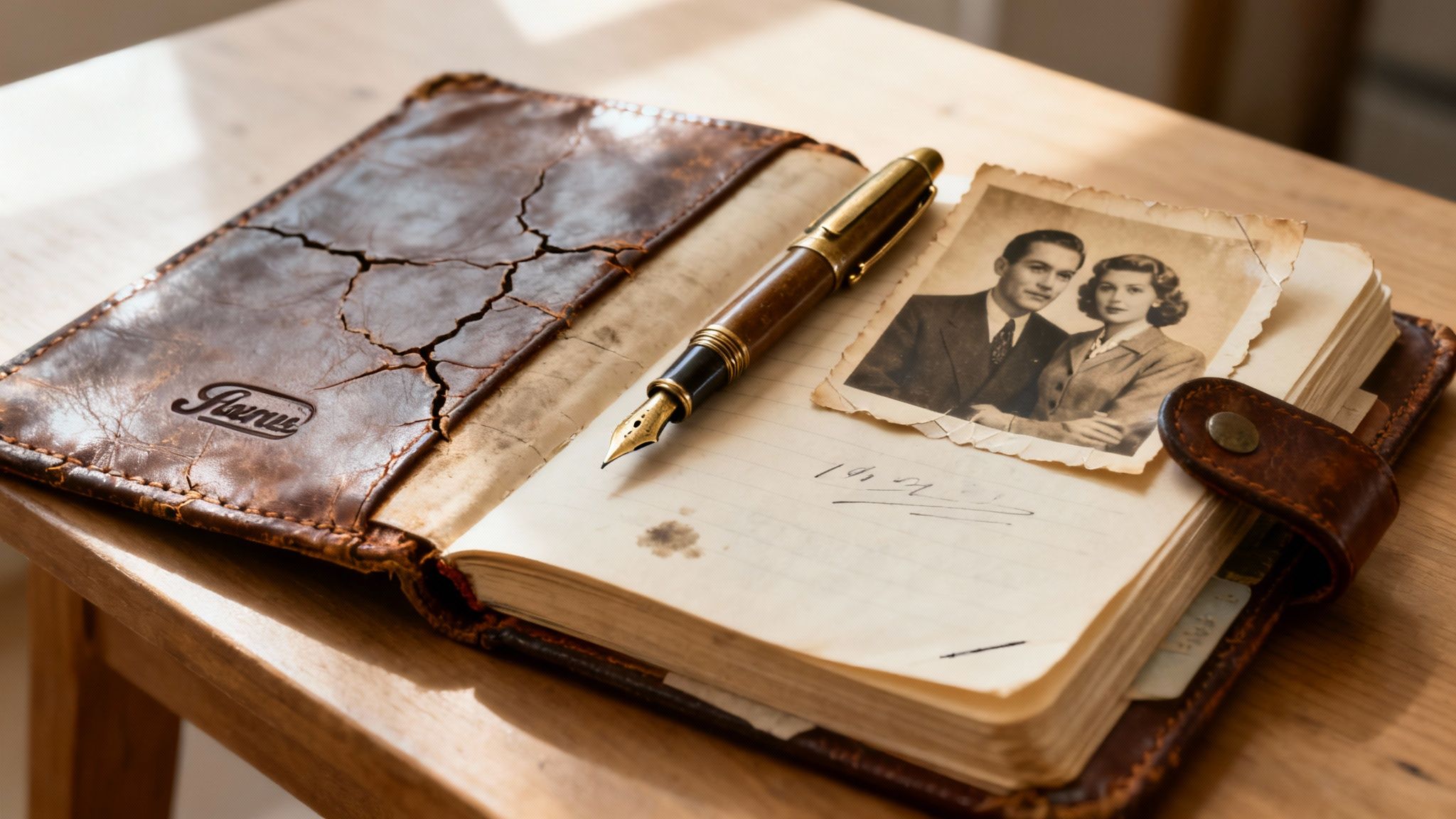
The most memorable moments in TV often have a physical object right at their heart, acting as a silent narrator. These items anchor us in the world of the show, making fictional places feel tangible and real. From the intricate goblets in a sprawling fantasy epic to the period-correct typewriter in a historical drama, every single prop is a deliberate choice made to build a cohesive, believable world.
This process starts long before the cameras even think about rolling. It kicks off with a deep dive into the script, where every mentioned or implied object gets flagged. This is a real team effort between the director, production designer, and prop master, all working together to nail down the visual language of the story.
Weaving Narrative with Objects
Every single prop has a job to do. It might be there to establish a timeline, reveal a sliver of a character's personality, or even foreshadow events to come. Just look at how a character's living space is dressed. Is it cluttered with books and old photographs? That suggests a nostalgic, intellectual person. Or is it minimalist and sterile, hinting at someone cold and detached?
These aren't happy accidents; they are the fundamental building blocks of character and environmental storytelling. A seemingly insignificant background item can add layers of meaning that dialogue simply can't.
Take a character's mobile phone, for example. It instantly tells you about their socioeconomic status, their relationship with technology, and even the time period of the show. A vintage flip phone tells a completely different story than the latest smartphone. This is the subtle but powerful work of tv props in action.
The right prop doesn't just fill a space on set; it fills a gap in the story. It provides context, history, and emotional weight, transforming an ordinary scene into an unforgettable moment for the audience.
The Role of Hero Props
Of course, in the vast world of props, some items carry more narrative weight than others. We call these "hero props." These are the objects that characters interact with directly, the ones that are absolutely central to the plot.
Hero props often become the iconic symbols of a show. Think of a detective’s signature magnifying glass or a wizard's distinctive wand. They aren’t just accessories; they are extensions of the characters themselves and are pivotal to moving the story along. Sourcing or creating these hero props is a meticulous process. They have to be durable enough for repeated handling and detailed enough for those unforgiving close-up shots. You can learn more about how to choose props that enhance your story in our detailed guide on the subject.
Selecting these key items involves some serious collaboration. The art department works hand-in-glove with the director to ensure the prop fits their vision, and with the actor to make sure it feels natural to handle. The end goal is to find or create an object that is both visually compelling and functionally perfect for the story being told. This foundational work sets the tone for the entire production's visual identity, proving that in television, even the smallest objects can tell the biggest stories.
Developing Your Production's Prop Brief
Before you even think about hiring or buying a single prop, you need a plan. Not just a rough idea, but a detailed, robust document that acts as the bible for the entire art department. This is your prop brief. Get it right, and it becomes the single source of truth that prevents costly mix-ups and ensures every object on screen is telling the right story.
This whole process starts where everything does: the script. You’ll need to comb through every scene, every line of dialogue, and every character action to pull out any object that's mentioned or interacted with. This isn't just about making a list; it’s the groundwork for building a believable world. A solid brief is what separates a cluttered, confusing set from a visually rich environment where all tv props have a clear purpose.
From Script Page to Master List
The first practical step is a systematic script breakdown. This means reading through it multiple times, each pass with a specific goal. Your first read-through might be to identify the "hero" props – those absolutely vital items the plot hinges on, like a forged document or a character's lucky charm.
A second pass could focus on character props, the smaller things that reveal personality without a word of dialogue. Think about the specific model of laptop a tech CEO uses, or the battered, well-loved mug a weary detective drinks from. Each choice tells a story.
This process helps you categorise everything, which is crucial for budgeting and scheduling down the line. You'll build a master prop list—a living document that will expand and change as pre-production gets going. Make sure to distinguish between a "hand prop" (something an actor handles) and general "set dressing" (the stuff that fills the environment). Their sourcing and on-set management needs are often very different.
Defining Prop Specifics and Authenticity
With a master list in hand, the real detail work begins. This is where you move from general ideas to concrete specifics that align with the director and production designer's vision. "Old book" isn't nearly enough detail. You need to be precise.
If you’re working on a drama set in the 1950s, that "old book" needs a cover design that’s authentic to the era. Its condition is just as important. Is it a pristine, unread copy or a treasured volume with a cracked spine and dog-eared pages? These details are what make a world feel real to an audience.
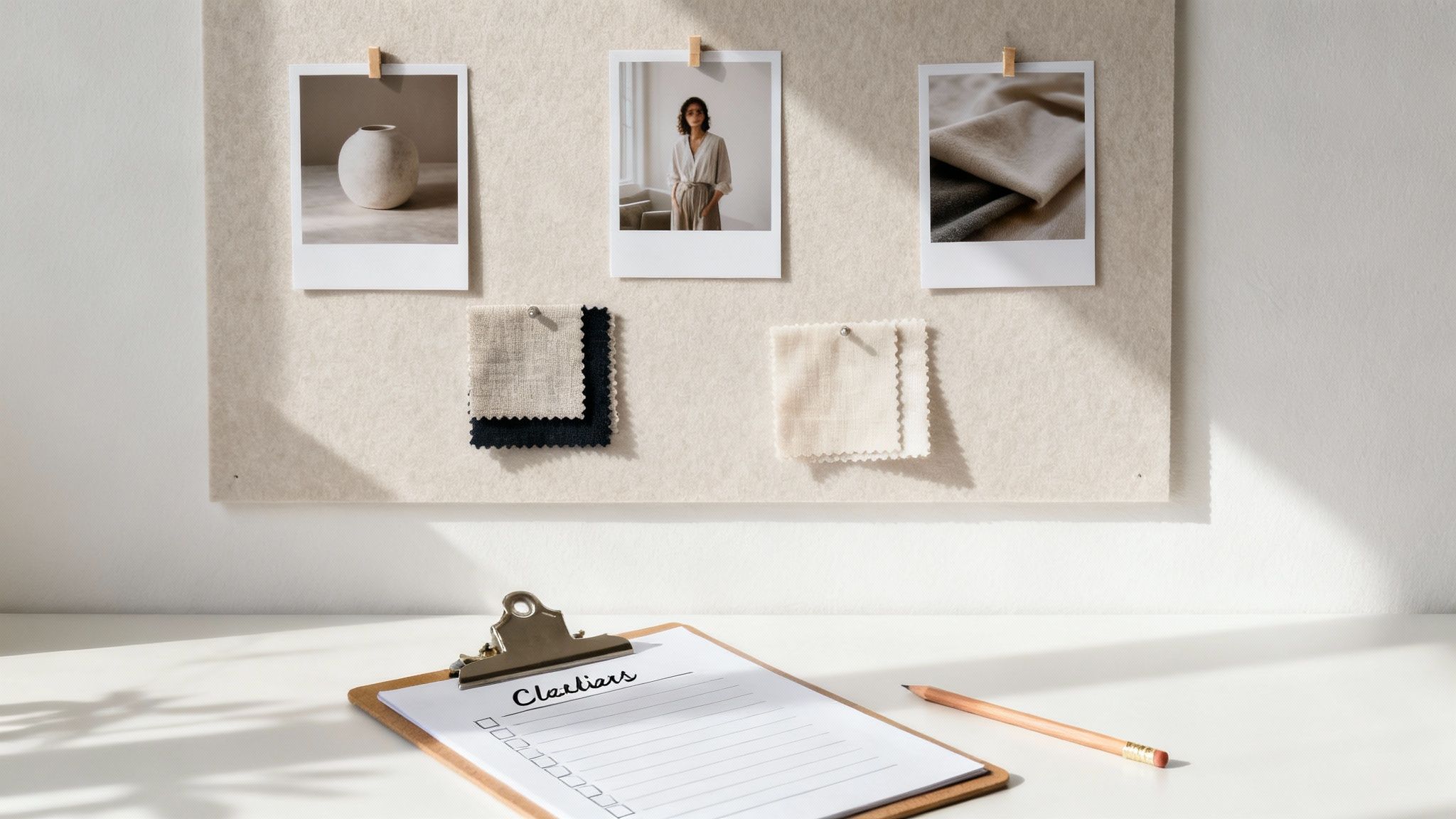
This stage is all about collaboration. Mood boards are your best friend here, combining reference photos, colour palettes, and even fabric swatches to create a shared visual language. It ensures everyone is on the same page, from the choice of cutlery in a dinner scene to the design of a sci-fi gadget.
A prop brief is more than a shopping list; it's a blueprint for the physical world of your story. Precision in the brief translates directly to authenticity on screen, saving valuable time and resources during the pressures of shooting.
Addressing Safety and Special Requirements
Beyond the look and feel, your prop brief has to tackle the serious business of safety and logistics. This is a non-negotiable part of the process, as certain tv props come with risks that have to be professionally managed.
For instance, any scene involving a fight or a stunt will likely require "breakaway" props. Instead of using a real glass bottle, you’ll need a replica made from sugar glass that can be smashed safely. Your brief must specify exactly which props need breakaway versions and, crucially, how many duplicates you'll need for multiple takes.
Fire safety is another huge one. All fabrics used on set, from curtains to sofa upholstery, must meet strict fire-retardant standards. Your prop brief needs to document these requirements, ensuring every material sourced is certified and compliant. Skimping on these details isn't just a safety hazard; it can shut down your production and land you in serious legal trouble.
To pull all this information together clearly, a checklist is indispensable. It forces you to think through every component, ensuring nothing is left to chance.
A comprehensive brief is your best defence against chaos on set. It leaves no room for ambiguity, ensuring a smooth, safe, and visually coherent production from start to finish.
Nailing Your Prop Budget and Schedule
Let’s be honest: great prop work is as much about spreadsheets and calendars as it is about creative flair. You can have the most incredible artistic vision, but without a solid budget and a tight schedule, it all falls apart. This is where the real graft happens—turning your prop brief into a workable plan that keeps the art department on track and in the black.
Creating a budget isn't just a shopping list; it’s a strategic game plan. You need to account for everything, from the star ‘hero’ props right down to the last piece of background clutter. A classic rookie mistake is underestimating the cost of small set dressing, but trust me, those little items add up fast and can absolutely wreck your budget if you haven't planned for them.
Building a Budget That Actually Works
First things first, you need to break it all down. A proper budget will have clear lines for buying, hiring, and making props from scratch. Your hero props—the ones that might need to be custom-built for close-ups and repeated use—will probably eat up a good chunk of your cash. On the flip side, background tv props are almost always cheaper to hire in bulk from a good prop house.
But don't just think about the price tag. A smart budget anticipates all the hidden costs that can sneak up on you. I've seen these trip up productions time and time again:
- Transport: Getting props from A to B and back again costs money. This is especially true for big, heavy furniture or anything particularly delicate.
- Insurance: This isn't optional. You need proper cover for hired items in case something gets damaged or goes missing on set. It’s a non-negotiable part of the process.
- Repairs & Spares: What’s the plan if your hero prop breaks mid-take? Your budget needs a contingency for on-set fixes or having a few duplicate "breakaway" versions ready to go.
- Consumables: This is your catch-all for things like fake blood, prop food, or the bits and pieces the art department needs for those last-minute tweaks on set.
The scale of this operation in the UK is massive. The TV and film industry is booming, and you can see it in the numbers. In the first quarter of 2025 alone, production spend hit a staggering £632 million – that’s nearly three times what it was in the same period of 2024. A huge part of that was high-end television (HETV), which saw £990 million poured into 39 different shows. That level of investment shows just how complex and demanding the world of television props has become. You can read more about UK production spending trends on Screen Daily.
Keeping Your Prop Schedule in Sync
Once the money is sorted, it’s all about timing. The prop schedule has to be perfectly locked in with the main production timeline, making sure every single object is on set, ready to go, at the exact moment it's needed.
Get this wrong, and you can cause chaos. I’ve seen it happen: the main unit is ready to shoot a crucial scene, and the one prop everyone is waiting for is still sitting in a warehouse across town. It’s a costly, embarrassing mistake that a detailed schedule is designed to prevent.
A prop schedule isn't just a list of dates. It's the logistical heartbeat of the art department, dictating the flow of every item from sourcing and fitting to its final moment on camera.
Your schedule should track the entire journey of each key prop. This means setting deadlines for sourcing items, finalising custom builds, and arranging delivery times. It’s also crucial to block out time for "prop fittings" with the actors. Giving them a chance to get a feel for a key item before the cameras are rolling makes for a much smoother, more natural performance.
And remember, a schedule is a living document. Scenes get cut, shooting days get shuffled, and your plan needs to be flexible enough to roll with the punches. Constant communication with the assistant director and production manager is the only way to stay ahead of changes. It’s that proactive approach that stops your department from descending into chaos and keeps everything running like a well-oiled machine.
Navigating Prop Houses: To Hire or to Buy?
For any art department, the hire-versus-buy question is a constant balancing act. It’s a decision that echoes through your budget and schedule, making it one of the first critical calls you’ll make in pre-production. There's no one-size-fits-all answer here; the right choice always comes down to the prop's specific role, the scale of your production, and your long-term needs.
The decision often hangs on screen time and story significance. If you're dealing with a 'hero' prop—something central to the plot that an actor will handle across dozens of scenes—then buying or commissioning a custom build is usually the way to go. This gives you total control, eliminating the risk of a hire agreement causing chaos with your shooting schedule.
But for background set dressing or items that only appear in a single scene, hiring is nearly always the smarter, more efficient route. Prop houses are genuine treasure troves, packed with pieces that can instantly conjure a specific era or mood without the crippling expense of buying everything outright.
This quick decision tree helps visualise that initial thought process. It’s a simple way to guide you towards a custom build, a hire, or even realising an item isn't needed after all.
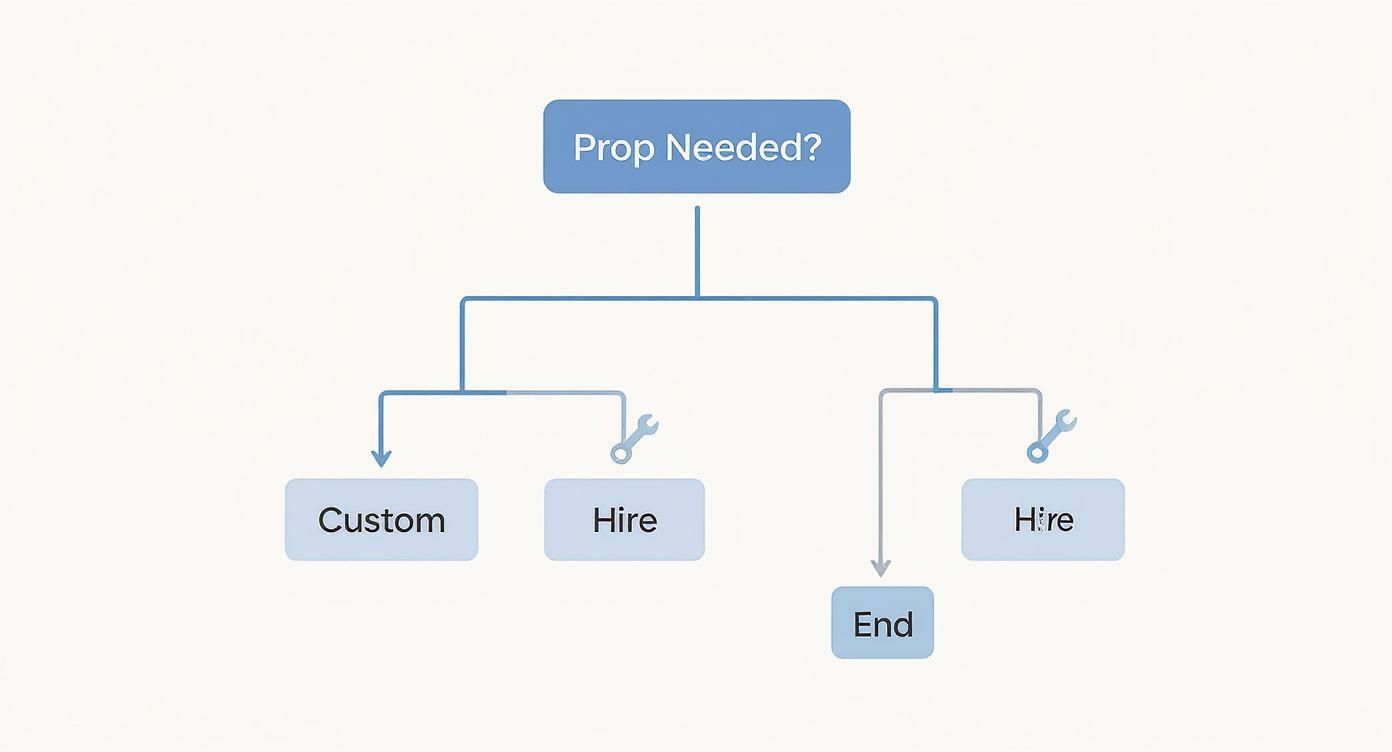
As the chart shows, the first question is always whether the prop is a unique, story-specific item or something more generic you can find for hire.
When to Hire Props
Hiring is the lifeblood of the props world, and for good reason. It’s a sustainable model that grants productions access to an incredible catalogue of items that would be impossible to own for every single project.
Hiring is the obvious winner in scenarios like these:
- Period Pieces: Need to dress a Victorian drawing room or a 1970s office? A good prop house will have everything from authentic furniture to period-correct telephones and typewriters. Trying to buy all that would be a financial and logistical nightmare.
- Large-Scale Set Dressing: If you’re filling an entire restaurant with tables, chairs, and cutlery, hiring in bulk is the only sane choice. It saves a staggering amount of time and money.
- Specialist or Bulky Items: A full suit of armour, a vintage jukebox, or complex medical equipment? These are perfect hire items. They’re expensive to purchase, a pain to store, and often need the kind of expert handling that prop houses are set up to provide.
The UK's television production industry is a powerhouse, estimated to be worth £14.2 billion and supporting around 7,726 businesses. This means there's a vast network of prop houses ready to meet the constant demand for quality tv props. You can dig deeper into the stats on the UK's television production industry on IBISWorld.
When to Buy Props
While hiring is often the default, sometimes buying a prop is the smartest move. It gives you ownership and freedom, which can be absolutely essential in certain situations.
Think about buying when you find yourself in these circumstances:
- Destruction Required: If a prop has to be smashed, burned, or blown up on screen, you have to own it. Prop houses, understandably, don't appreciate their inventory being returned in a bin bag. You'll probably need to buy several identical items for multiple takes.
- Heavy Modification: Does the script call for a chair to be painted a garish colour or have its legs sawn off? If an item needs to be permanently altered, buying is your only option.
- Long-Running Series: For a show set to run for several seasons, buying key set pieces that appear in every episode can be cheaper in the long run than hiring them repeatedly. Think of a character's signature armchair or the main family's dining table.
Building a good relationship with prop house staff is an underrated superpower. They know their stock inside out and can often unearth the perfect, unexpected item that elevates your entire set design. Don't just send emails; pick up the phone or visit in person.
Working Effectively with Prop Houses
Once you’ve decided to hire, success hinges on clear communication. Start by researching prop houses that specialise in the period or style you're after. Send them your prop brief with plenty of reference images and be as specific as you possibly can.
Always ask for detailed quotes that break down the weekly hire cost, any deposits, and the terms for transport and insurance. Before you commit, it’s vital to inspect the items in person if possible. A photograph can’t always show the scuffs and scratches that might be glaringly obvious in a close-up. To help weigh up your options, our guide on DIY vs professional prop hire offers additional insights.
Finally, nail down the logistics. Agree on firm dates and times for collection and return, and make sure you have the correct insurance in place before anything leaves their warehouse. A smooth, professional process ensures you’ll be welcomed back for your next production.
On-Set Management and Prop Continuity
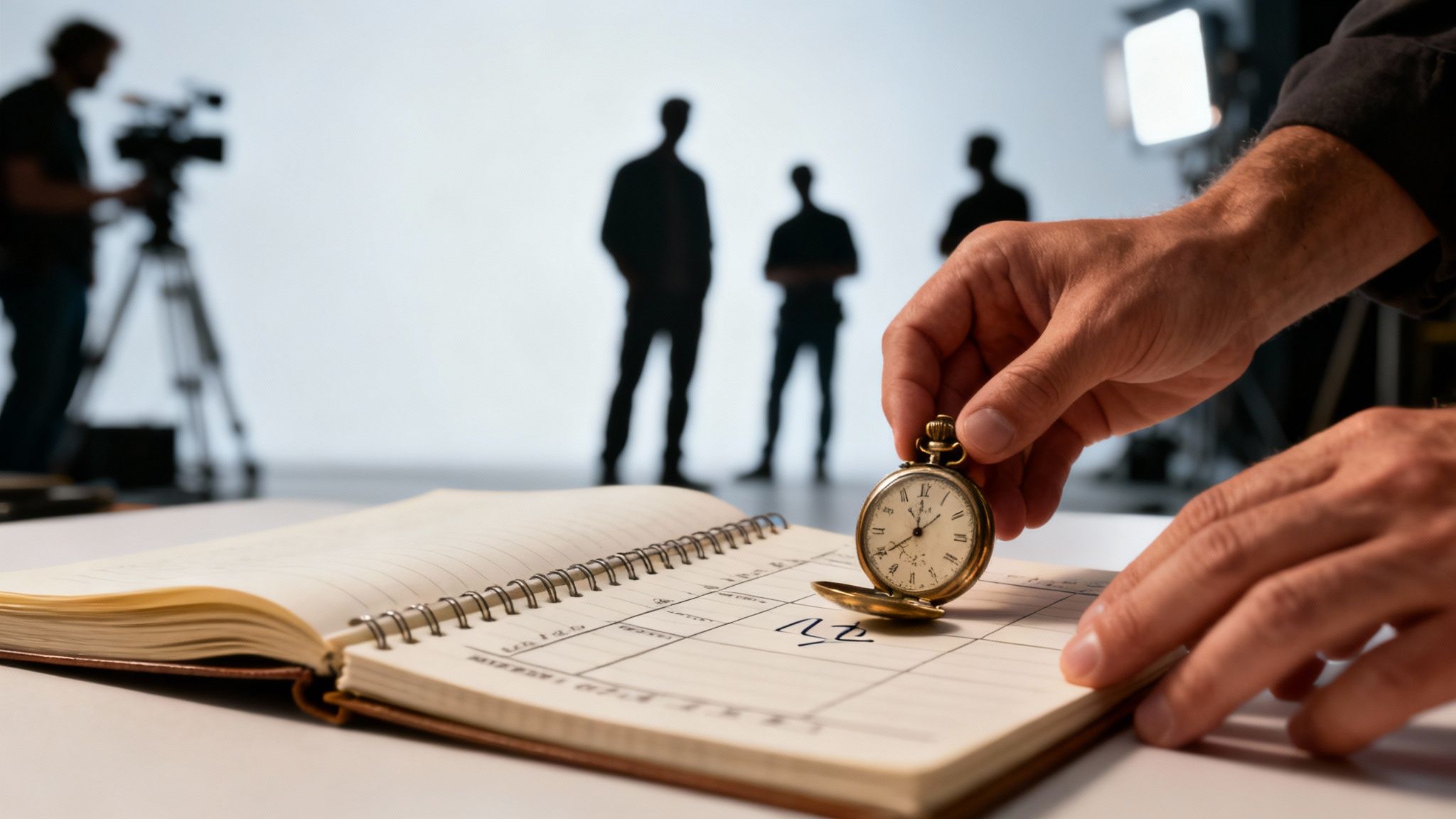
Once your carefully sourced tv props land on set, the real work begins. This isn't the end of the process; it's the start of the high-pressure phase where a collection of objects is transformed into a seamless part of the story through meticulous on-set management and an almost obsessive focus on continuity.
The prop master and their team become the guardians of the physical world during filming. Their responsibilities are huge, from placing each prop perfectly for a take to resetting every single item to its exact starting position for the next one. This precision is what allows a scene, often filmed out of sequence over several hours or even days, to feel like a single, unbroken moment to the audience.
The Art of the Reset
Every time a director calls "cut," the prop team springs into action. If a character sips from a glass, the liquid level has to be reset. If a letter is opened, a fresh, sealed envelope must be ready for the next take. This constant cycle of setting and resetting is the backbone of a smooth shooting day.
This fast-paced environment demands a hyper-organised approach. Props are usually laid out on a dedicated "prop table" just off-set, clearly labelled by scene and character. This system ensures that any item an actor needs is immediately on hand, preventing costly delays while the entire crew waits.
The recent surge in high-end TV production has put even more pressure on prop departments. In 2024, the combined spend for film and high-end TV production hit £5.6 billion, a significant rise from the previous year. This boom, however, has also brought challenges, with some suppliers facing instability that can create vulnerabilities in the supply chain for crucial on-set items. You can explore more data on UK production spending and its impact on Screenglobal Production.
Maintaining Flawless Continuity
Continuity is the invisible art that keeps an audience immersed in your story. A continuity error—a half-empty glass that’s suddenly full again, a book that moves across a table on its own—can instantly shatter the illusion and pull a viewer right out of the narrative. Preventing these mistakes is a core duty of the prop team.
I’ve learned from decades in this business that you can't rely on memory alone. You need a system.
- Photographic Records: A quick, clear photo of the set just before the first take is non-negotiable. It provides an undeniable visual reference for every single reset.
- Continuity Logs: A detailed written log, often managed with the script supervisor, notes the exact position and state of key props at the beginning and end of each take.
- Digital Tools: Many teams now use tablets with specialised software to annotate photos directly on set, marking prop positions with pinpoint precision.
A prop master's greatest skill is often their memory, but their greatest tool is their system. A robust continuity process is the safety net that catches human error before it makes it to the final cut.
Effective collaboration is also critical. The prop master must be in constant communication with the script supervisor, who is the ultimate authority on continuity across all departments. This partnership ensures that the state of the props aligns perfectly with the actors' dialogue, wardrobe, and actions from one shot to the next. It’s this coordinated effort that separates amateur productions from professional ones, ensuring every object on screen serves the story without distraction. For a deeper dive into this world, have a look at our article exploring the essential role of prop hire in TV production.
Common Questions About TV Props
Even with the best plan in the world, you're going to have questions. After three decades in this business, I've heard them all. Whether you're a seasoned producer or just finding your feet in the art department, a few common queries always pop up. Let’s get them answered.
What's the Real Difference Between Props and Set Dressing?
This is the big one, and it trips people up all the time. The answer is simple: interaction.
- Props: Short for 'properties', these are any items an actor physically handles or uses in a scene. It's the mobile phone they answer, the book they're reading, or the weapon they're holding.
- Set Dressing: This is everything that builds the world but isn't directly touched by the actors. Think furniture, curtains, artwork on the walls, and rugs. It's the backdrop to the action.
- Wardrobe: This is easy. It's simply the clothes, costumes, and accessories worn by the actors.
The line can get blurry, and that's where the rule of interaction comes in. A chair is just set dressing. But the moment an actor picks it up to throw it across the room? It becomes a prop.
How Do You Handle Props That Get Destroyed on Screen?
Ah, the satisfying smash. This is where meticulous planning and budgeting are non-negotiable.
For any prop that needs to be broken, smashed, or ruined, the props department has to source or create multiples. These are often called 'breakaway' props if they need to shatter safely (like a bottle made from sugar glass) or simply 'repeats'. The budget has to cover buying or making several identical items to allow for multiple takes.
It's absolutely vital to talk to the director and stunt coordinator to figure out the exact number you'll need and any specific safety requirements for the materials.
A classic mistake is underestimating how many repeats you'll need for a stunt. I always advise planning for at least three to five versions of any breakaway prop. It avoids costly delays when the first couple of takes don't go quite right.
What's the Best Way to Source for a Period Drama?
Getting historical accuracy right is a craft in itself. There’s no single magic source; it’s about a multi-pronged attack.
Your first stop should always be a specialised prop house. Places like ours have huge, well-catalogued inventories of period-specific items that will form the backbone of your set. From there, you supplement. Scour antique shops, flea markets, and online auction sites for those unique, characterful pieces that add texture.
For those rare items you just can't find, you’ll need to turn to custom fabrication by skilled artisans. And throughout it all, consulting with historical advisors is key to making sure every detail, from the model of a typewriter to the design on food packaging, is authentic to the era.
Can We Use Branded Products on Screen?
Using recognisable brands without permission is a legal minefield. Tread very, very carefully here.
To avoid trademark infringement, your production needs to get legal clearance. There are two main ways to do this. First, you can get direct permission from the brand, which often happens as part of a product placement deal.
The second, and more common, route is to use 'greeked' items. This is where brand names and logos are cleverly altered, covered, or obscured so they're unrecognisable on camera. While some generic uses might fly under the radar, it is always safest to talk to the production's legal team. Using a brand in a negative light without explicit consent is a fast track to serious legal trouble.
At House of Props, we have over three decades of experience helping productions find the perfect items to tell their stories. From period dramas to modern thrillers, our extensive collection and expert team are here to bring your vision to life. Explore our catalogue and get a quote for your next project at https://www.houseofprops.uk.