
Record player vintage: A Prop Master’s Guide
A vintage record player is more than just an object; it’s a storytelling machine. With a single prop, you can instantly transport an audience to a specific time, set a mood, and bring a layer of authentic, tangible warmth to any scene.
Why Vintage Record Players Steal the Scene
In the world of production design and event styling, very few items have the immediate character of a vintage record player. Think of it as a visual shortcut. It instantly communicates nostalgia, sophistication, or even youthful rebellion, depending on its design.
For a film set in the 1960s, a colourful Dansette player doesn't just fill a space; it screams of cultural shifts and teenage dreams. Drop a sleek 1970s turntable with a silver-faced amplifier into a room, and you immediately define a character as cool, discerning, and modern for their time. This ability to say so much with one object is pure gold for creators.
This isn't just some niche interest for collectors, either. The charm of analogue music has staged a major comeback, and that cultural shift has massively boosted the appeal of using a genuine record player as a prop. In fact, vinyl sales in the UK hit 5.9 million units in 2023—the highest figure since 1990. You can read more about this vinyl revival on The Revolver Club.
More Than Just a Prop
Choosing the right record player goes far beyond just what looks good. It’s about building a believable world. The right model can play several roles on set or at an event:
- An Instant Time Stamp: It grounds the scene in a specific decade, no questions asked.
- A Character Revealer: The choice of player and the records beside it can say volumes about a character's personality and tastes.
- A Focal Point: It can act as a hero prop, drawing the viewer's eye in a crucial moment—that iconic needle drop.
A vintage record player is never just background noise. It's an active participant in the story, adding texture, sound, and a sense of history that digital effects just can't replicate.
This guide will give you the practical knowledge you need to select, prepare, and feature these timeless pieces. Whether you're dressing a background set for a theatre production or placing a hero prop for a cinematic close-up, understanding the nuances of these machines will elevate your project's visual and emotional punch.
Matching the Player to the Period
Choosing the right record player vintage isn't just about filling a space on set; it's about historical accuracy. Get it wrong, and you instantly pull the audience out of the story. It's the equivalent of a knight checking his smartphone. Every decade had its own design language, making these players perfect little time capsules.
Think of it like this: a 1950s record player was the family saloon of the audio world. Big, dependable, and often built directly into a heavy wooden cabinet. These all-in-one consoles were designed to be the undisputed centrepiece of the living room—a statement of post-war stability and a genuine technological marvel.
The infographic below shows the long, fascinating journey of vinyl's popularity. You can see the huge gap between its first golden age and the modern revival, which is exactly why there’s such a demand for these authentic vintage pieces today.
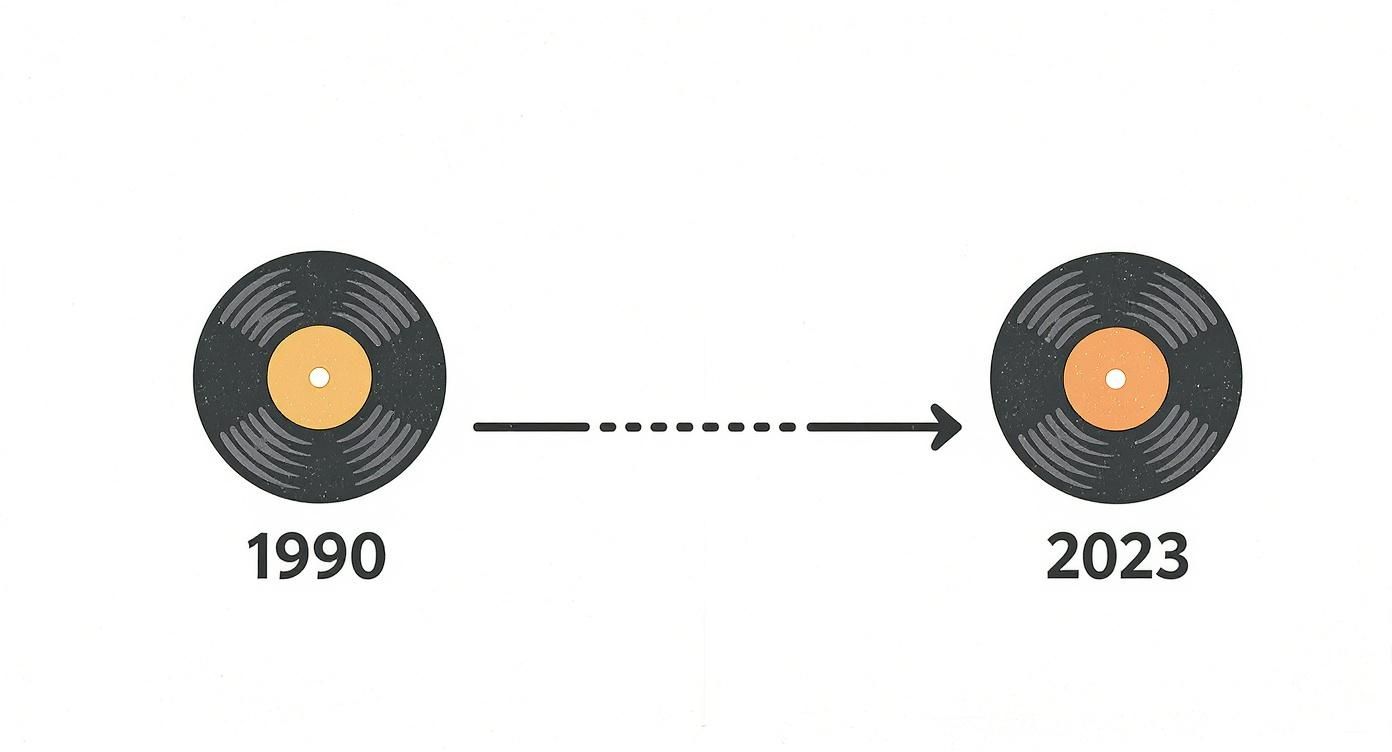
This visual timeline really hammers home how the aesthetic we love in vintage players is tied directly to vinyl's massive comeback since the early 2000s, connecting whole new generations to the format.
To help you place a player in its proper context, here’s a quick guide to the distinct styles of each key decade.
Vintage Record Player Eras at a Glance
This table is a quick reference for identifying the general look and feel of players from the '50s through to the '80s. Use it to quickly match a prop's design to your scene's time period.
| Era | Common Styles | Key Materials | Typical Setting |
|---|---|---|---|
| The 1950s | All-in-one furniture consoles, radiograms | Dark wood, Bakelite, tweed fabric | The family living room, a formal space |
| The 1960s | Portable "Dansette" style, compact, boxy | Brightly coloured plastic, faux leather | A teenager's bedroom, a party, a bedsit |
| The 1970s | Separate components, sleek turntables | Brushed aluminium, wood veneer, perspex | A discerning adult's hi-fi setup, a den |
| The 1980s | All-in-one integrated "tower" systems, linear tracking | Black or silver plastic, sharp angles | A modern flat, a music lover's bedroom |
As you can see, the shift from a shared family appliance to a personal, high-tech gadget is clear in the design evolution. Let's dig into the details.
The Swinging Sixties
As the culture shifted, so did the hardware. The 1960s blew the old console concept apart, bringing in a wave of portability and personality. Players got smaller, lighter, and came in a riot of colours.
- Design: Often cased in vibrant plastic or colourful faux leather, these were made to be grabbed by a handle and taken to a friend's house.
- Target Audience: This was audio for the youth. They were marketed directly to teenagers and young adults, reflecting a completely new, youth-driven pop culture.
- Iconic Brands: Brands like Dansette became shorthand for the entire era. Their players are now essential props for capturing that unmistakable '60s spirit.
This evolution from a static piece of furniture to a portable accessory perfectly mirrors the decade's new sense of freedom and energy.
The Sleek Seventies
The 1970s brought a more serious, almost scientific approach to audio. The humble all-in-one player was pushed aside in favour of component-based systems: separate turntables, amplifiers, and speakers.
For a 1970s setting, the goal is to create a 'hi-fi' system. The look became more technical and sophisticated. Think brushed aluminium faceplates, warm wood veneers, and chunky knobs and dials that signalled a real focus on sound quality over simple convenience.
This was the golden age of the turntable as a distinct, respected piece of equipment. A sleek, silver-faced deck from this period tells you a character is discerning, mature, and properly invested in the listening experience itself. It marks the shift from casual music playing to a dedicated audiophile hobby.
The Plastic Fantastic Eighties
By the 1980s, the natural materials of the '70s felt dated. Black plastic was king, and systems were often sold as imposing, all-in-one stacks from a single brand.
These integrated systems—often a turntable, cassette deck, and radio tuner in a single tower—were all about convenience and a clean, futuristic aesthetic. While they might lack the warmth and charm of earlier models, an '80s record player vintage system is absolutely vital for authentically recreating a bedroom or living room from that decade.
Understanding these clear visual cues ensures your prop choice doesn't just fill a space—it tells the right story for the right time.
Functional or Just for Show? Making the Right Call
Right out of the gate, you’ve got a big decision to make: does this record player vintage prop actually need to play a record? This choice between a working 'hero' prop and a non-working 'static' one will ripple through your budget, sourcing time, and what’s needed on set. There’s no right or wrong answer here; it all comes down to the story you’re telling.
A functional record player delivers a hit of authenticity that’s impossible to fake. If the script calls for a close-up of the needle dropping, the platter spinning, or an actor physically using the machine, you absolutely need a working model. That tactile, mechanical reality adds a layer of believability that audiences can feel, pulling them deeper into the world of the scene.
But that authenticity comes with strings attached. A working vintage player can be a diva, requiring careful handling and maybe even an on-set technician to coax it into performing. They’re also pricier to hire or buy, a reflection of their rarity and mechanical complexity.
The Case for Static Props
On the flip side, a static, non-functional prop is often the most practical and reliable choice. If the record player is just background dressing in a wider shot, its ability to play music is completely irrelevant. Its job is purely aesthetic—to set the period and add a bit of texture to the room.
Static props are almost always kinder to your budget and much easier to find. This makes them perfect for dressing large sets or for productions on a tight schedule. You also get peace of mind, eliminating the risk of a technical hiccup halting the shoot.
The only question you need to ask is this: "Does the action demand that the player works?" If the answer is no, a static prop is nearly always the smarter, safer, and more economical option.
Making the Right Decision
To figure this out, look at your shot list. A bit of planning can stop you from splashing out on a working prop whose main features will never even be seen by the audience.
Here’s a quick way to break it down:
-
Go for a Functional Player if:
- The camera needs a close-up of the needle, tonearm, or the spinning record itself.
- An actor has to operate the player as a key piece of their performance.
- You need to capture authentic, on-set sound like the needle's crackle or the motor's hum.
-
Stick with a Static Prop if:
- The player will only ever be seen in the background or in medium to wide shots.
- Nobody is going to interact with it directly during the scene.
- Your main goal is to nail the period look without any technical fuss.
Ultimately, it’s a balancing act between your visual storytelling needs and the practical realities of production. For that one hero moment, a working record player vintage is irreplaceable. For everything else, a beautifully styled static prop will do the job perfectly—saving you time, money, and a few potential headaches on set.
Prepping Your Prop for Its Close-Up
So, you’ve tracked down the perfect vintage record player for your project. Great! But the job’s not quite done. Getting it from the shop to the set in one piece—and making sure it’s ready for its moment in the spotlight—is where the real work begins. This is the pre-flight check that turns a dusty find into a reliable, camera-ready asset.
First things first: transport. These old players are more delicate than they look. A bumpy ride can easily knock a tonearm out of alignment or crack a fragile perspex lid. Always, always secure the tonearm to its rest. Use a twist-tie or its original clip if it's still there. If you can, take the platter off and wrap it separately to protect the spindle. Honestly, bubble wrap and a sturdy box aren't optional; they're essential.
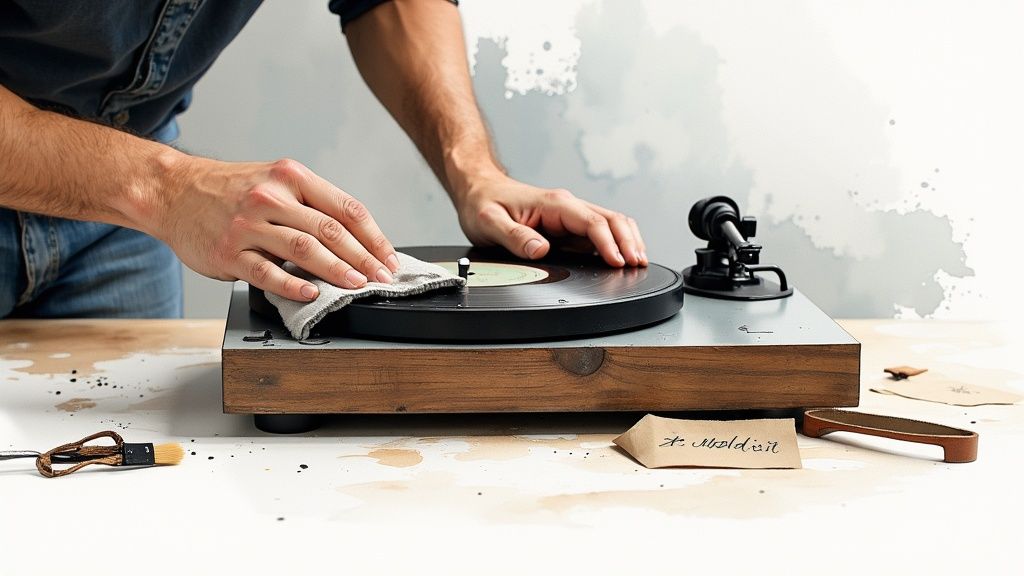
Gentle Cleaning for the Camera
The aim here isn't to make it look brand new. Far from it. You’re trying to enhance its character by getting rid of any distracting dust and grime, while keeping that authentic patina that tells its story. Harsh chemicals are a definite no-go—they can strip the finish or melt old plastic in a heartbeat.
Start simple with a soft microfibre cloth to get the surface dust off. For any stubborn marks on the wood or plastic body, a slightly damp cloth with a single drop of mild soap usually does the trick. Just make sure to test it on a hidden spot first. For the metal parts like the platter and tonearm, stick to a dry cloth to keep moisture away from the mechanics.
Think of it less like cleaning and more like conservation. The aim is to highlight the prop's age and history, not erase it. A little wear and tear adds to the authenticity, but a layer of dust just looks neglected.
Essential Safety and Functionality Checks
Before you even think about plugging a vintage electronic prop into a socket on set, a safety check is non-negotiable. Old wiring can become brittle and dangerous over time, and that’s a risk nobody wants to take.
Here's a quick checklist to run through:
- Electrical Cord: Look over the entire length of the power cord. See any cracks, frayed bits, or exposed wires? If so, don't plug it in. The safest bet is to have any older electronics professionally PAT tested (Portable Appliance Testing) to make sure they're up to modern safety standards.
- Plug: Check that it’s a modern, safe UK plug with the correct fuse. Some really old models might have outdated two-pin plugs that need replacing before they go anywhere near a mains socket.
If you’ve got a model that needs to actually work on cue, there are a few more things to look at to guarantee it performs smoothly.
The Mechanical Pre-Flight Check
For a working record player vintage prop, you need it to be reliable. A technical glitch can ruin a take. These quick checks can save you a world of pain.
- Check the Stylus (Needle): Take a gentle look at the very tip of the stylus. If it's bent, broken, or clogged with fluff, it’s not going to track the groove properly. You’ll get dodgy sound, or worse, it’ll just skip.
- Inspect the Belt: Many players from the '70s and '80s use a rubber belt to turn the platter. Lift the platter off and have a look. If the belt is slack, sticky, or has cracks in it, the turntable won't spin at the right speed. It’ll need replacing.
- Test the Platter: Give the platter a light spin with your hand. It should turn smoothly without any scraping or grinding noises. If it does, you know the bearing is in good nick.
Taking a few minutes to run through these steps means your vintage record player won't just look the part—it'll be safe, sound, and ready to perform when the cameras start rolling.
Styling and Sound Design for Authenticity
Getting your hands on the perfect vintage record player is a great start, but it's only half the job. To make it truly believable on screen or stage, you need to build a world around it. The hardware itself is just the centrepiece; real authenticity comes from the subtle art of staging and sound design. It’s how you turn a simple object into a convincing part of the story.
This all begins with the environment. A record player never just floats in a room by itself. It needs friends that speak the same historical language. Think about the records themselves—the album art is an instant giveaway of the era. Putting a 1960s Dansette next to a copy of Fleetwood Mac's Rumours from 1977 is a jarring mistake that any sharp-eyed viewer will spot immediately.
Building a Convincing Scene
To create a scene that feels lived-in and genuine, you have to sweat the small stuff. It’s all the little details surrounding the player that sell the illusion to an audience.
- Period-Accurate Vinyl: Do your homework. Look up the popular albums from the exact year your scene is set. The record labels, the cover designs, even the scuffs and wear on the sleeves add layers of realism. For a late '60s scene, you might have some Carole King or Simon & Garfunkel lying around.
- Appropriate Furniture: The player needs a proper home. A big 1950s radiogram would be the proud focal point of the living room, whereas a '70s turntable might sit on a low-slung teak cabinet next to a growing vinyl collection.
- Associated Décor: What else would be in that room? Think about the ashtrays, the magazines on the coffee table, or the style of lamp in the corner. These small touches are what anchor the scene in a specific time and place.
This level of detail is absolutely vital. As one of the prop stylists at House of Props puts it, "The smalls—the little items around the main prop—are what truly convince an audience. They turn a set into a world."
Capturing Authentic Sound
Once the visuals are dialled in, it's time to think about what you hear. The sound of a vintage record player is just as iconic as its look, full of a warm, imperfect character that clean digital audio just can't replicate.
If you’re using a working player, the goal is to capture its unique voice. This is where you need to think like a sound engineer. Get a microphone in close to pick up not just the music, but all the subtle, mechanical noises that scream authenticity—the soft click of the tonearm engaging, the gentle hum of the motor, and, of course, that signature crackle of the needle finding the groove.
These subtle sounds are storytelling gold. They create a sense of presence and nostalgia that is instantly recognisable and emotionally resonant, grounding the audience firmly in the moment.
For a static, non-working prop, that sound has to be built from scratch in post-production. And this is much more than just dragging a generic "vinyl crackle" sound effect into the timeline. A professional sound designer builds a layered audio experience. You’d mix a high-quality recording of the song with separate tracks for the needle drop, the surface noise, and even the faint whir of the platter. This meticulous work ensures that even a silent record player vintage prop sounds completely and utterly real.
Common Prop Mistakes and How to Avoid Them
You can have the perfect vintage record player, looking every bit the part, but a few small, easily missed details can shatter the whole illusion. These are the kinds of slip-ups that are simple to sidestep once you know what to look for, but they’re absolutely crucial for keeping your scene authentic. Get them wrong, and you create jarring distractions that pull an audience right out of the moment, undoing all your careful work.
One of the most common blunders I see is a period-inaccurate vinyl pairing. Slapping a 1980s record on a 1960s Dansette is a historical mismatch that anyone with a passing interest in music will spot in a heartbeat. Always do a quick check on the release dates of any albums you plan to use on-screen to make sure they fit your scene's timeline.
Hiding Modern Intrusions
Another immersion-breaker is letting modern tech sneak into the shot. The sleek, black plastic of a new power cable or the tell-tale gleam of a contemporary audio lead can completely torpedo an otherwise perfect period set.
The goal is to make the prop look as if it has always lived in that space. Any modern element acts like a visual alarm bell, reminding the audience they are watching a production.
To get around this, you have to be meticulous about concealing or disguising any modern wiring. A bit of gaffer tape that matches the colour of the floorboards or skirting board can work wonders. You can also strategically place other props—a stack of books, a well-positioned plant—to hide cables from the camera's prying eye.
Don't Forget the Backup
This one’s non-negotiable. For any hero prop that’s central to the action, you absolutely must have a backup. Vintage kit can be notoriously temperamental, and a mechanical failure on the day of a shoot can lead to eye-wateringly expensive delays. Hunting down a specific model of vintage record player isn't something you can do in five minutes, either.
Always plan for the worst. Having an identical or very similar backup model on standby is your insurance policy against technical gremlins. This simple bit of prep ensures a single prop failure won’t derail your entire production schedule, saving you from a world of logistical pain.
A Few Final Pointers on Vintage Record Players
Over the years, a few questions about using vintage record players on set crop up time and time again. Getting your head around these common queries beforehand can save a world of headaches on a busy shoot day, making sure your prop sings rather than stalls.
Can a Non-Working Player Look Real on Camera?
Absolutely, and it's a common trick of the trade. For a simple static shot, all you need to do is rest the tonearm on a stationary record. Job done.
If you need the platter to spin for a take, a gentle push by hand just before the director calls "action" often does the trick. For longer scenes, a small, hidden motor can be fitted underneath to keep it turning. The crucial sound of the needle hitting the groove and the music playing? That’s almost always added in post-production anyway.
The single biggest safety issue with any vintage electrical prop is the wiring. Old, brittle cables are a serious fire and shock hazard. Always, always have any player that will be plugged in PAT tested by a qualified technician before it goes anywhere near a set.
Do I Need Period-Accurate Vinyl?
If the camera is getting up close and personal, then yes – it's vital. A keen-eyed viewer will spot the wrong record label, album art, or even the wrong thickness of vinyl in a heartbeat. Those little details can pull an audience right out of the story.
For background dressing where the records are just part of the scenery, you can get away with less specific or even replica vinyl. But for any 'hero' prop that gets its moment in the spotlight, pairing it with the correct, period-accurate record is non-negotiable. It’s these small touches of authenticity that really sell the world you’re building.
For distinctive, quality-assured props that bring your vision to life, explore the extensive collection at House of Props. With decades of experience serving film, theatre, and events, we provide the authentic pieces that make your story believable. Find your perfect prop at https://www.houseofprops.uk.
Article created using Outrank