A Guide to the Leather Topped Desk in Set Design
More than just a piece of furniture, a leather topped desk is a serious storytelling tool. Get it right, and it can instantly telegraph status, era, and character, making it one of the most important choices a set decorator or prop master can make.
The Leather Topped Desk as a Storytelling Prop
In film, theatre, or a photoshoot, every single object on set is telling part of the story. A desk is often the centrepiece of a room like an office or a study, so it naturally carries a lot of narrative weight. Add a leather top to that desk, and you’re introducing layers of meaning that a simple wooden surface just can’t touch.
I always tell people to think of it like casting for furniture. A huge Victorian partner's desk with a dark, embossed leather surface immediately screams old-world power, tradition, maybe even a touch of generational wealth. That one prop can ground an entire period drama, telling the audience everything they need to know about a character's place in the world before they've even said a word.
Communicating Character and Status
On the flip side, a sleek, modern leather topped desk with minimal tooling might suggest ruthless efficiency in a corporate thriller. The choice of leather—whether it’s worn and cracked or polished and perfect—speaks volumes. A distressed surface hints at a character who is hardworking, perhaps a writer or a detective whose life is practically etched into the furniture they use every day.
The desk really does become an extension of the character, reflecting their personality, habits, and social standing. This is a core concept in set design; props are chosen for their ability to push the narrative forward, not just because they look nice. You can learn more about this in our detailed guide on how to choose props that enhance your story.
A prop is never just a prop; it's a silent narrator. A leather topped desk can whisper tales of ambition, power, intellect, or decline, making it one of the most expressive pieces you can place on a set.
Establishing the Narrative World
Beyond the character, the desk helps to build the world of the story—the mise-en-scène. The style of the desk helps establish the time and place, anchoring the audience in the story's reality. Its condition, and the clutter or lack thereof upon it, provide clues about the plot and the atmosphere of the scene.
Here are just a few ways a leather topped desk can shape the world you're building:
- Period Dramas: An ornate Georgian or Edwardian desk can instantly transport the audience back in time, adding a crucial layer of authenticity.
- Legal or Political Thrillers: A large, imposing desk can symbolise the power and authority of a judge, politician, or high-powered lawyer.
- Character Studies: The meticulous organisation—or chaotic mess—on a writer's desk can reveal their creative process and current state of mind.
This guide will walk you through the essential steps of identifying, selecting, and styling the perfect leather topped desk to bring your creative vision to life. By understanding its role as a key narrative element, you can turn a simple piece of furniture into a powerful storytelling tool.
Identifying the Style and Era of Your Desk
Picking a leather topped desk for a production isn't just about finding a handsome piece of furniture. It demands a sharp eye for historical accuracy. The right desk anchors a scene in its time period, but the wrong one can pull an audience straight out of the story. Think of it as a costume for your set—every detail tells a story about the era it belongs to.
Getting to grips with the subtle differences between periods is key. An elegant Georgian desk is a world away from an ornate Victorian one, and both are completely distinct from the sturdier, more functional desks of the Edwardian age. The clues are all there in the details: the shape of the legs, the type of wood, the style of the hardware, and the tooling on the leather itself.
This section is your practical field guide to spotting those visual cues. We'll break down the signature characteristics of each major period, turning what can be complex design history into actionable knowledge for your next production.
The infographic below shows just how powerful a prop a leather topped desk can be, helping to define a character, establish an era, and signal status all at once.
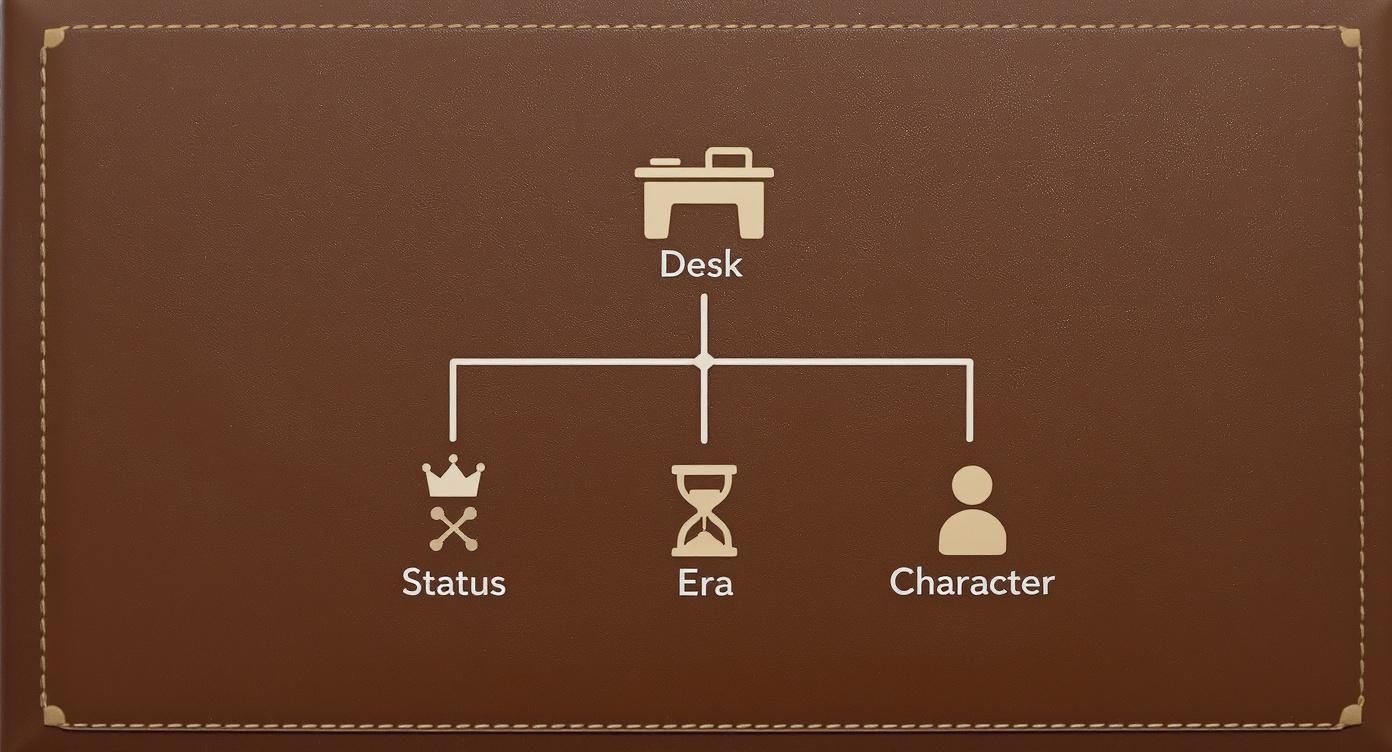
As you can see, the desk often sits at the very centre of the storytelling, influencing core narrative elements of a production.
Georgian Grace and Elegance (1714-1830)
The Georgian period was all about symmetry, proportion, and classical inspiration. A Georgian leather topped desk is the epitome of understated elegance, prioritising fine craftsmanship over fussy ornamentation.
- Wood: Mahogany was the undisputed star of this era, loved for its rich, reddish-brown colour and incredible durability. You'll also find walnut in earlier pieces.
- Legs: Look for slender, tapering legs. Popular styles include straight, square-tapered legs or the more decorative cabriole leg, which curves outwards before narrowing at the ankle.
- Hardware: Drawer pulls were typically simple, often brass bail handles or small, round knobs that complemented the desk's refined look without overpowering it.
Victorian Grandeur and Ornamentation (1837-1901)
In stark contrast, the Victorian era embraced opulence with open arms. Desks from this period are often larger, heavier, and far more decorative. They were designed as status symbols, reflecting the wealth and industrial might of the time.
A Victorian desk is a substantial piece, perfect for conveying power and tradition in a scene. The tradition of using leather in British furniture has deep roots. In the 18th and early 19th centuries, the industry was central to manufacturing, and a government report in 1807 led to deregulation that massively increased the variety of leather available for fine furniture. You can read more about the historical UK leather economy and its impact on furniture.
A key takeaway for set decorators is that Victorian design is all about making a statement. The more carved details, intricate inlays, and bold features a desk has, the more likely it is to be from this period of lavish expression.
Common features to watch for include:
- Wood: Dark woods like mahogany, walnut, and oak were heavily favoured.
- Legs: Turned legs, often with intricate carvings, were very popular. Many desks featured heavy pedestal bases instead of individual legs, providing substantial support and storage.
- Leather Tooling: The leather surfaces were frequently embossed with elaborate gold tooling, often featuring floral or geometric patterns around the border.
Edwardian Simplicity and Craftsmanship (1901-1910)
The Edwardian era marked a move away from Victorian excess towards lighter, more refined designs. While still rooted in tradition, Edwardian desks are less imposing and often show influences from movements like Art Nouveau.
These desks often strike a fantastic balance, making them incredibly versatile for scenes set in the early 20th century. For those building a complete period set, understanding these nuances is critical. Our guide on 10 essential props every period drama needs can help you source other key items to complement your choice of desk.
To help you on set, here’s a quick-reference table for spotting the differences at a glance.
Era Identification Guide for Leather Topped Desks
| Era | Key Wood Types | Leg Style | Common Leather Colours | Distinctive Features |
|---|---|---|---|---|
| Georgian (1714-1830) | Mahogany, Walnut | Slender, tapered, cabriole | Dark green, deep red, black | Symmetry, understated elegance, simple brass hardware. |
| Victorian (1837-1901) | Dark Mahogany, Oak, Walnut | Turned, carved, pedestal bases | Dark red, brown, dark green | Ornate, heavy, elaborate gold tooling on leather, lots of carving. |
| Edwardian (1901-1910) | Lighter Mahogany, Satinwood | Straight, tapered, sometimes inlaid | Tan, lighter greens, red | Lighter feel, less ornamentation, often incorporates inlay and marquetry. |
By learning to spot these distinct characteristics, you can select a leather topped desk that not only looks authentic but genuinely enriches the story you're trying to tell.
How to Choose the Right Desk for Your Scene
Picking the perfect leather topped desk for a production isn't just about what looks good. I've seen it countless times – a desk has to work for the camera, the actors, and the crew. While getting the period details right is vital, the technical side is what separates a good set from a great one. It's a balancing act.
The process always starts with the physical space. A desk that looks magnificent in a prop house showroom can completely overwhelm a small set, or worse, get lost in a grand one. It’s all about scale and proportion, not just to the room itself, but to the actor who'll be using it.
Matching the Desk to the Actor and Set
An actor has to look like they belong at their desk. A towering actor crammed behind a delicate little writing table just looks awkward and pulls the audience right out of the scene. On the flip side, a petite actor can be completely dwarfed by a huge partner's desk, which might undermine the authority their character is supposed to have.
Before you even think about hiring, consider these points:
- Actor's Height and Build: Does the desk's height and depth let the actor sit, stand, and move naturally? Their eyeline and posture have to feel real for the character.
- Set Dimensions: Get the tape measure out. You need to know the exact floor space, but don't forget to leave room for camera positions, lighting rigs, and people moving around.
- Action Requirements: What does the script demand? Is the actor just writing a letter, or are they about to slam their fists on it in a rage? The desk needs to be the right size for the action.
Camera and Lighting Considerations
How a desk looks on camera is probably the most critical technical challenge. The finish on a leather top can either create beautiful cinematic texture or a logistical nightmare for your lighting department.
The number one enemy is glare. A glossy, highly polished leather surface might look stunning in person, but stick it under powerful studio lights and you’ll get harsh reflections and hotspots. It's a massive distraction. Our eyes are naturally drawn to bright, shiny things, and you want the audience looking at the actor, not a blinding reflection.
My advice, honed over years of dealing with this exact problem, is to opt for a desk with a matte or semi-matte leather finish. It’s nearly always the safest bet for film and TV. This kind of surface absorbs more light than it reflects, which minimises glare and keeps the look consistent, no matter where you put the camera.
If the script absolutely insists on a high-gloss desk, then the art department needs to have a serious chat with the director of photography. They might need to bring in special diffusion screens, polarising filters, or completely rethink their lighting plan just to control the reflections. A matte finish simply gives you more options on a busy set.
Ensuring Continuity and Durability
Productions are chaotic, and continuity is king. If a desk is the centrepiece for several scenes shot weeks apart, it needs to look exactly the same in every single one. This gets even trickier if the script calls for the desk to get damaged.
Think about a scene with a big fight or a character sweeping everything off the surface in a fury. You can't risk doing that to a genuine antique. Your beautiful "hero" prop is perfect for the quiet dialogue scenes and close-ups, but you don't want to see it splintered during a stunt.
This is where a good prop house is worth its weight in gold. We can often supply a visually identical "stunt double"—a more robust reproduction that can take a beating. Using two props—a hero and a stunt version—means you get the perfect look for your key shots while protecting the valuable antique. It keeps the production moving and the budget in check. Never underestimate the practical side of a prop's durability.
Dressing the Desk to Build a Character
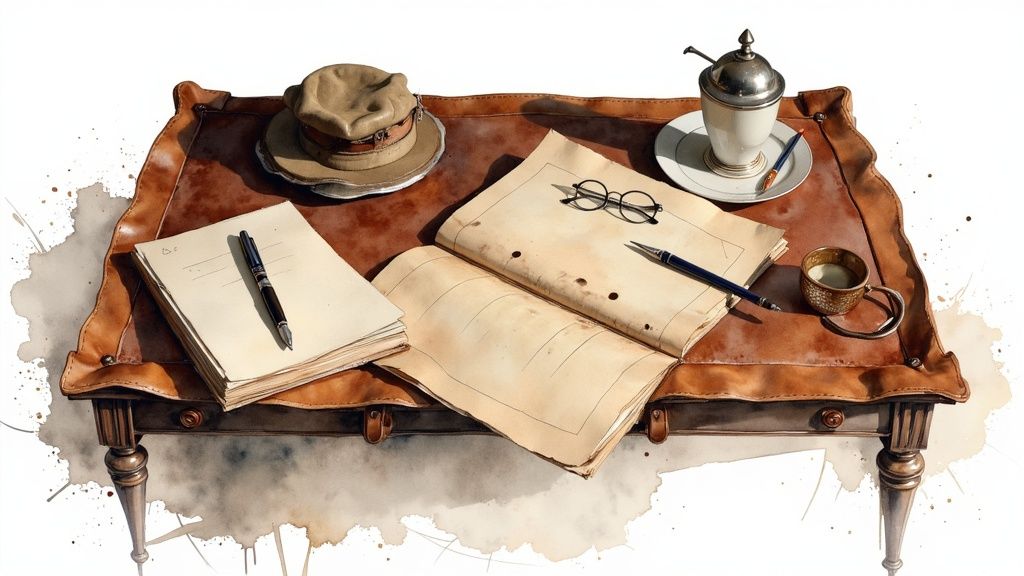
A bare leather topped desk is just a piece of furniture. A dressed one tells a biography. The items scattered across its surface—or meticulously arranged—are the clues that reveal a character's profession, personality, and private life. This is where a set decorator steps in and becomes a visual storyteller, using props to say more than a page of dialogue ever could.
The real art is in choosing objects that feel completely authentic to the person who sits there. Think about a driven detective's desk. It’s probably a controlled chaos of case files, cold coffee cups leaving rings on the worn leather, and maybe an overflowing ashtray. That setup immediately tells us about their dedication, the long hours they work, and their vices.
Now, picture the desk of a calculating villain. Theirs would be pristine, a picture of power and absolute control. A single, expensive fountain pen, a perfectly aligned blotter, and perhaps a rare, dangerous artefact placed just so. Every item is a deliberate choice, reflecting a mind that leaves nothing to chance.
Props That Tell a Story
The key is to think beyond generic office supplies. Every prop needs to serve the narrative, building a richer, more believable world around your character. It’s amazing how different items can shape an audience's perception.
- Profession and Status: A barrister’s desk might feature heavy, leather-bound legal texts and a barrister’s wig on a stand. A CEO’s could display a family photo in a silver frame next to exclusive industry awards, showing us both their personal motivations and professional success.
- Habits and Quirks: Does the character doodle on scrap paper during phone calls? Are there half-finished crossword puzzles lying around? These tiny details are what make a character feel human.
- Time and Place: Props have to be right for the period. A 1940s journalist's desk would have a hefty manual typewriter and a press pass, not a sleek laptop.
The quality of the desk itself is a huge part of this story. In the modern UK, the leather industry supports specialist manufacturers who produce incredible high-end furniture, including the kind of premium leather topped desk that just screams quality and tradition. These pieces, often made with prime bovine leather, reflect a legacy of craftsmanship that adds a powerful layer of authenticity to any set. You can discover more about the UK's specialist leather furniture industry and its heritage.
Lighting to Create Mood and Texture
Once the desk is dressed, lighting is your final tool for bringing it to life. The way light plays across the leather surface can dramatically shift the entire mood of a scene.
Think of light as a paintbrush for emotion. A single, focused beam from a desk lamp can create a sense of intimacy or isolation, drawing the viewer’s eye to a crucial clue—a letter, a photograph, a weapon.
Soft, ambient light can make a study feel warm and inviting, a safe haven for a thoughtful character. On the flip side, harsh, angular lighting with deep shadows can create suspense or menace, perfect for a thriller. This kind of lighting also brings out the texture of the leather itself, highlighting every scratch and grain and adding to the desk's own story. With careful prop placement and thoughtful lighting, a simple leather topped desk becomes a dynamic, essential part of the world you’re building.
Sourcing and Hiring the Perfect Prop Desk
Sooner or later, every production hits a key decision point: do we hire or buy the props we need? When it comes to something as significant as a leather topped desk, the answer isn't always obvious. For most productions I've worked with, hiring from a specialist prop house is the smartest move, and not just because of the upfront cost.
Buying a genuine antique desk is a serious investment. Beyond the price tag, you've suddenly got to worry about storing it, moving it without damage, and maintaining it long after the cameras have stopped rolling. Hiring neatly sidesteps all of that. It gives you immediate access to a massive, curated library of period-correct desks without the long-term baggage.
This is all about flexibility. You might need a grand Victorian partner's desk for a barrister's office one month, and a sleek, minimalist Art Deco piece for a gangster's hideout the next. Hiring makes that possible within a predictable budget. Prop houses aren't just furniture warehouses; they're archives of storytelling tools, run by people who get the unique pressures of production.
The Prop Hire Process, Step by Step
Getting the right prop on set, on time, is a well-oiled process. If you know the steps, it’s completely straightforward.
- Initial Search and Enquiry: Start by browsing the online catalogue or, even better, visit the prop house in person. Get specific with your search terms—try "Edwardian leather topped desk" or "mahogany pedestal desk." Once you've got a shortlist, fire off a quote request with your required hire dates.
- Consultation and Selection: This is where the real value kicks in. Talk to the experts. Explain the scene, the character, the period, and any action that's planned around the desk. A seasoned prop specialist can often suggest options you hadn't even considered and will confirm critical details like weight and dimensions.
- Logistics and Delivery: Once you've made your choice, it's time to finalise the hire agreement and sort out transport. Don't forget to ask the important questions: Can the desk be taken apart to get it onto a tricky set? What are the access requirements for the delivery lorry?
- On-Set and Returns: The desk arrives on set and is now in your care. When the hire period is up, the prop house arranges collection, gives the item a once-over, and the job is done.
A Period Drama Case Study
Let's imagine a production team is shooting a drama set in a 1920s barrister's chambers. They need a desk that screams authority, tradition, and old money. A quick search of the House of Props catalogue turns up a beautiful mahogany pedestal desk with a classic tooled green leather top.
They get in touch, and we talk it through. They confirm the dimensions will work with their set build and that its condition is flawless, which is essential for the planned close-up shots. We're able to confirm the piece's authenticity and even provide a little of its history, adding a layer of unseen richness to the production. This is a perfect example of how the role of prop hire in TV production is about creative partnership, not just moving furniture.
It helps that the UK’s leather goods sector is still going strong, meaning authentic, high-quality pieces are out there. The Leather, Hide & Skin Wholesaling industry in the UK has seen steady growth, hitting an estimated revenue of £374.3 million, with bovine leather making up the lion's share. You can see more on this at the UK leather wholesaling industry on IBISWorld.
By hiring, the production gets more than just a prop. They get a piece of history and the peace of mind that it's fit for purpose. This frees them up to focus on what really matters: telling a brilliant story.
Caring for a Hired Desk on a Busy Set
A hired leather topped desk isn't just another piece of set dressing; it's a valuable asset that needs a bit of respect. On a fast-paced, often chaotic set, accidents are bound to happen. Looking after it properly is crucial, not just to keep the prop looking its best for your scenes, but to dodge costly damage fees and keep your relationship with the prop house a good one.
Think of it like borrowing a classic car for a shoot. You wouldn't leave it out in the rain or let the crew lean on it with their keys dangling. The same principle applies here. A few simple, preventative steps can save a world of headaches, making sure the desk goes back in the same condition it arrived in.
Gentle Cleaning and Maintenance
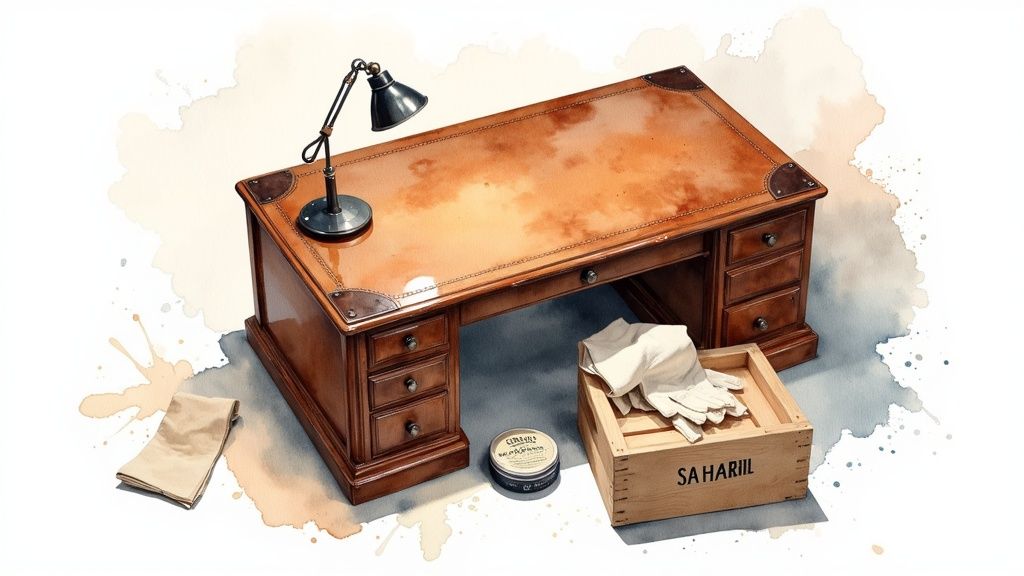
Dust and everyday grime are the biggest enemies of old leather, slowly breaking down the surface. Before you even think about reaching for a spray bottle, the gentle approach is always the right one. A quick, regular wipe-down with a soft, dry microfibre cloth will handle most of the day-to-day upkeep on set. Simple.
For small smudges or spills, less is definitely more. Steer clear of commercial furniture polishes, cleaning sprays, and any harsh chemical cleaners. These things can strip the leather’s natural oils and ruin the finish for good.
The golden rule for cleaning a hired leather topped desk is simple: start with the mildest method you can. A hasty clean with the wrong product can cause irreversible damage far worse than the original mark.
If it needs more than a quick dust, check with the prop house first. If they give you the green light, use a slightly damp cloth with a proper pH-balanced leather cleaner or a very, very diluted mild soap solution. Always test it on a hidden spot first, like underneath or on a back corner.
Protecting the Surface During Scenes
Active scenes are where the real risks lie. A character slamming down a heavy prop or dragging something sharp across the top can cause deep scratches or gouges in an instant. Good communication between the art department, the director, and the actors is the key to preventing this kind of accidental damage.
Here are a few practical ways to protect it on set:
- Use Protective Blotters: If a scene involves a lot of writing or heavy objects, lay a felt-backed leather blotter on the desk. It acts as a great buffer.
- Felt the Props: Stick small felt pads on the bottom of any heavy or sharp-edged props—think lamps, inkwells, or statues—that are going on the desk.
- Brief the Actors: Have a quiet word with the actors, gently reminding them to be mindful of rings, watches, or belt buckles that could scratch the surface if they lean on it.
Safe Transportation and Storage On Set
When the desk isn't in a shot, it needs to be stored safely. Don't leave it parked in a high-traffic area where it can get knocked by crew or equipment. If you need to move it, make sure it’s lifted correctly from the base—never dragged by its legs or top, which puts a massive strain on the joints.
Cover the desk with a soft, breathable blanket when it’s not being used, especially overnight. This protects it from dust, stray paint splatters, and accidental scuffs. Following these simple protocols shows you’re a pro and ensures a beautiful desk can keep telling stories for many more productions to come.
Your On-Set Questions, Answered
When you’ve got a piece as important as a leather topped desk on set, a few questions are bound to pop up. Here are some quick, practical answers to the queries we hear most often from set decorators, prop masters, and production teams.
Can We Fix Minor Scratches on a Hired Desk?
My honest advice? Don't. While a specialist leather cream might seem to hide a minor scuff, trying to fix a hired antique without getting the green light from the prop house is a huge risk. The wrong product can cause permanent damage, turning a small issue into a costly one.
Your first and only move should be to call the prop house immediately. They know their pieces inside and out and will tell you exactly what to do. Never reach for household polish or coloured wax as a quick fix – that’s a fast track to a damaged prop and a hefty bill.
What's the Best Way to Light a Leather Desk for Camera?
Lighting a leather topped desk is all about controlling reflections. You want to capture its rich texture and colour without creating a distracting glare for the camera.
- Go for Diffused Light: Softboxes or bounced light are your best friends here. They create a gentle, even light that minimises harsh hotspots.
- Angle Your Lights: Never light directly from above. Instead, set your lights at an angle to the surface, usually around 45 degrees. This reveals the texture without causing a mirror-like reflection.
- Use a Polarising Filter: This is a classic trick for a reason. A polarising filter on your camera lens is fantastic for cutting down glare from reflective surfaces like polished leather.
A bit of insider knowledge: a desk with a matte or semi-matte leather finish is always easier to light because it naturally absorbs more light. If the scene demands a high-gloss desk, make sure your lighting department is involved from the very beginning.
Is an Antique Desk More Expensive to Hire Than a Reproduction?
In a word, yes. A genuine antique desk will almost always cost more to hire than a modern reproduction. There are a few solid reasons for the price difference:
- Rarity and Value: True antiques are often one-of-a-kind pieces. Their value and scarcity are reflected in the hire price.
- Insurance Costs: We have to cover higher insurance costs for a valuable antique, just in case the worst happens.
- Specialist Handling: Antiques need a bit more TLC during transport and on-set handling, which adds to the overhead.
While a reproduction is a smart, budget-friendly choice for busy or action-heavy scenes, nothing beats the authentic character of a genuine antique. For those all-important hero shots, it’s often an investment that pays for itself on screen.
Can We Use a Leather Topped Desk for an Exterior Scene?
Using a real leather desk for an outdoor shoot is something I’d strongly advise against. Leather is a natural material, and it doesn't fare well against the elements. Direct sun will fade the colour and cause the leather to dry and crack, while any hint of rain or humidity can lead to warping, stains, and even mould.
If you absolutely must have a desk in an exterior scene, a durable reproduction is a much safer bet. Save the real antiques for the controlled environment of an indoor set.
At House of Props, we’re here to give you the expert guidance you need to choose, style, and look after the perfect props for your production. Discover our full range of furniture at House of Props and find the ideal desk to bring your story to life.
Article created using Outrank